
Amelia Earhart’s Sojourn in St. Paul
- Year
- 2026
- Volume
- 61
- Issue
- 3
- Creators
- Lisa Heinrich
- Topics
“Before Her Ascent to Fame”
by Lisa Heinrich
Over a hundred years ago, high school students in St. Paul were enjoying Central High School’s new location at Marshall Avenue and Lexington Parkway. A new school building, designed by local architect Clarence H. Johnston Sr., had been erected in 1912. Little did those students know that in their midst was a woman who would become one of the most famous Americans of all time.
Central High School has several claims to fame, including being the oldest high school in the state (formerly St. Paul High School, founded 1866) and boasting famed alumni like Gordon Parks, Charles Schulz, and Dave Winfield. Yet the short presence of Amelia Earhart rivals the school’s other bragging points in importance.
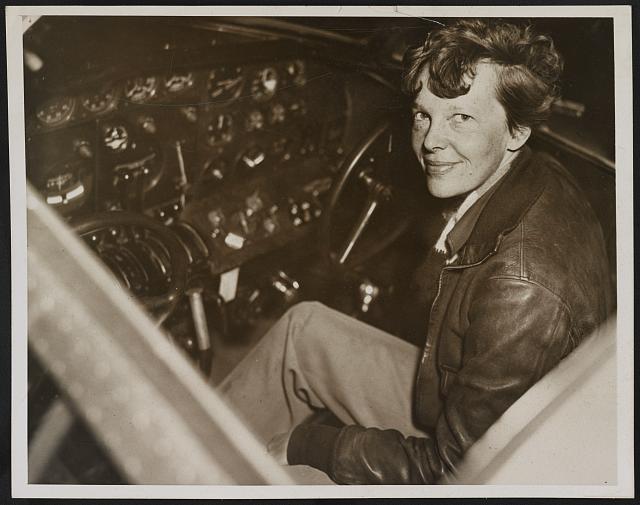
The Earhart Family’s Path to Minnesota
Amelia’s family consisted of her mother Amy, her father Edwin, and her sister Muriel. Both her parents had grown up in Kansas, Amy as the indulged daughter of a prosperous Atchison family living on Quality Hill, Edwin as the hardworking son of a poor minister. Amy’s father disapproved of their marriage and required the young attorney Edwin to wait until he was earning fifty dollars a month before he reluctantly allowed them to marry.1
The Earharts moved to Des Moines, Iowa, in 1908 when Edwin was offered a permanent position in the claims department of the Rock Island Railroad. It took Amy a year to find a house she thought suitable, during which time the girls stayed in Atchison with their grandparents. Edwin initially prospered in the job, and the family did well financially during this period, enough that they could afford to spend four summers on Lake Okabena in Worthington, Minnesota.2
Until this point, the two Earhart girls apparently had an idyllic childhood. They were very active and spent much time outdoors. They had a .22 rifle as a gift from their father, which they used to shoot rats. He also took them fishing and got them boys’ sleds and footballs.3 They were quite adventurous and built their own small roller coaster after seeing one at the St. Louis World’s Fair.4 They read voraciously and had a strong sense of justice and fairness, cultivated by their mother.
But, during the time in Des Moines, the family’s world began to crumble. As biographer Susan Butler describes it, “From a childhood spent with caring parents and grandparents, in comfort, surrounded by friends, all wants fulfilled, they would be plunged into the dismal ranks of broken homes and poverty. Des Moines marked the beginning of the end of Amelia’s childhood.”5
Edwin had begun to drink. Heavily. Amelia’s sister Muriel writes in her book, Amelia, My Courageous Sister: “The shadows began to fall on our gifted father, and the amenities of life had to be sacrificed for the necessities of existence.”6 In short, Edwin’s drinking eventually cost him his job, and “the reason for his release spread through the close-knit world of railroading,” Donald Goldstein and Katherine Dillon recount in Amelia.7 After a long job search, Edwin was offered a job as a clerk in the freight office for the Great Northern Railway in St. Paul. It was a decided reduction in status, but it was a steady job, and so the family moved to St. Paul in spring 1913. The journey to St. Paul was disorganized and “lugubrious,” as Amy wept when they left Des Moines.8
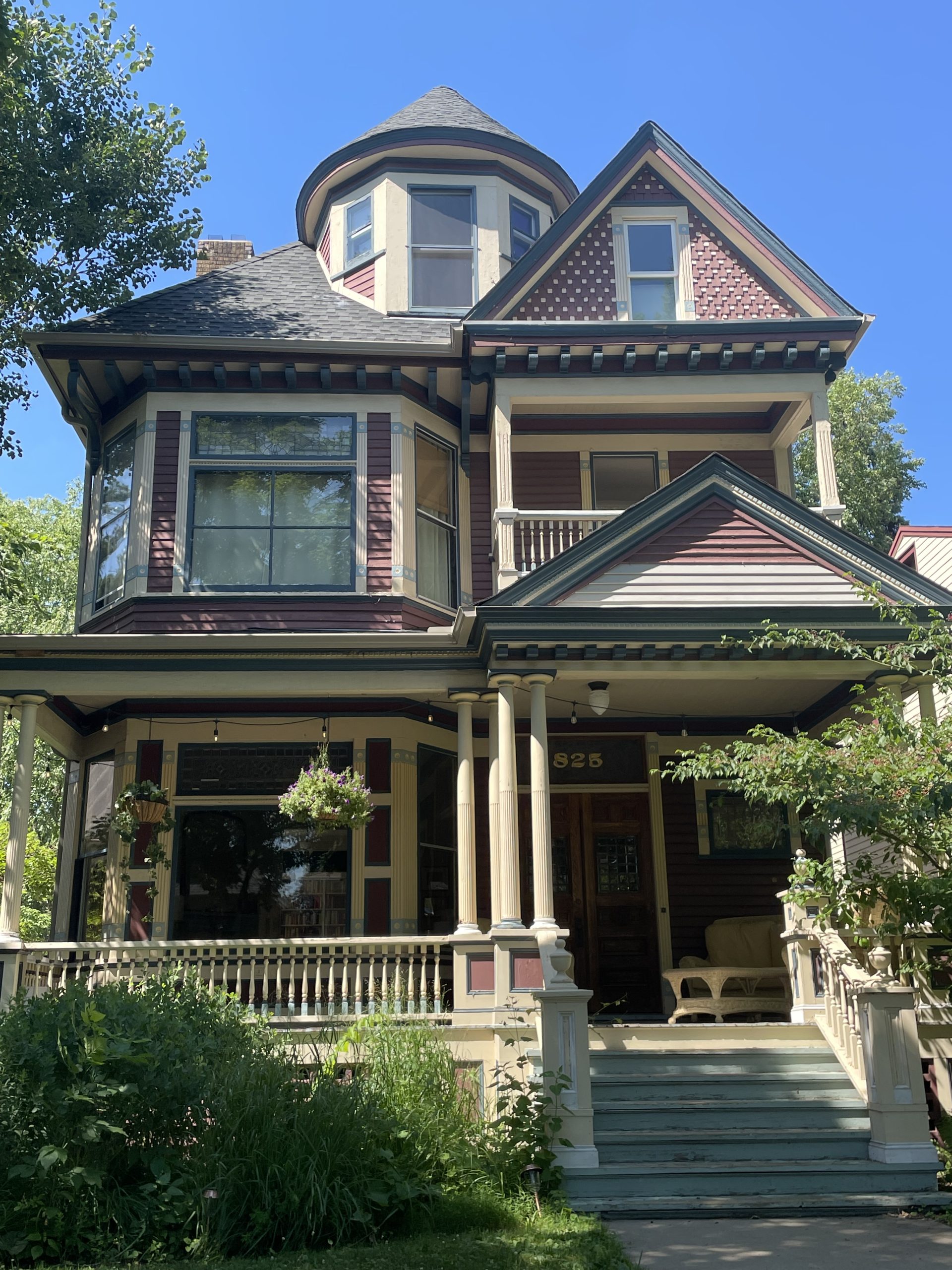
Hard Life on Fairmount Avenue
Edwin’s drinking continued to cause problems, unfortunately, and the family was in reduced circumstances. They rented a house at 825 Fairmount Avenue, but couldn’t afford the heating bills in cold weather, and so lived in a couple of rooms and shut the rest off. They had to scrimp on everything, such that the girls walked long distances to save money. When Edwin stumbled from a streetcar and was hit by an automobile, the ten-dollar hospital bill set them back so badly there was no money for spring clothes.9 According to biographer Doris L. Rich, “Amelia made Easter outfits for herself and Muriel, old blouses trimmed with new ribbon and skirts from silk curtains stored in the attic. Thread, ribbons, and buttons were bought with $3.40 earned by selling empty bottles she and Muriel found in the cellar.”10
In these reduced circumstances, the family endured ostracism even from relatives. Amy’s uncle, Charles Otis, was a respected man from a respected St. Paul family; George Otis had served as a state legislator and as mayor of St. Paul, and the family law firm had been established in 1857.11 Charles paid a short, perfunctory call on the Earharts and then ignored them.12 As it turned out, Amy’s brother Mark had undermined her relationship with her once-beloved uncle. Later it was discovered that Mark had been mishandling the family estate, and likely hadn’t sent Amy money that was her due and that he told Charles he had sent.13
Once, Muriel recounts, the girls were walking because they were one penny short of enough cash for a streetcar ride: “Homeward bound, laden with bundles and facing a biting wind, we felt an even more painful experience. Our great-uncle passed us in his car, and although he recognized us with a wave, he did not stop to offer us a ride.”14
Both girls were enrolled in Central High School, Amelia as a junior and Muriel as a freshman. Amy wrote to her brother Mark, “They [the girls] are both in the High School, taking the teachers course and Millie [Amelia] hopes to finish next year.”15
A 1932 Pioneer Press article, published after she had found acclaim, stated Amelia was a good student: “The record indicates that the woman who flew alone across the Atlantic ocean was more competent as a student of the German language than in other scholarly pursuits, although all her grades for the one year she attended Central were better than average.”16 Files at the Minnesota Historical Society contain a letter listing her grades for the two semesters and a letter from a former Central High librarian, Laurie C. Johnson: “I remember hearing Miss Dickson and others say that she was an attractive, friendly, red-haired teenager—not at all unlike her friends. Busy and popular . . .”17 She also played on the basketball team.18
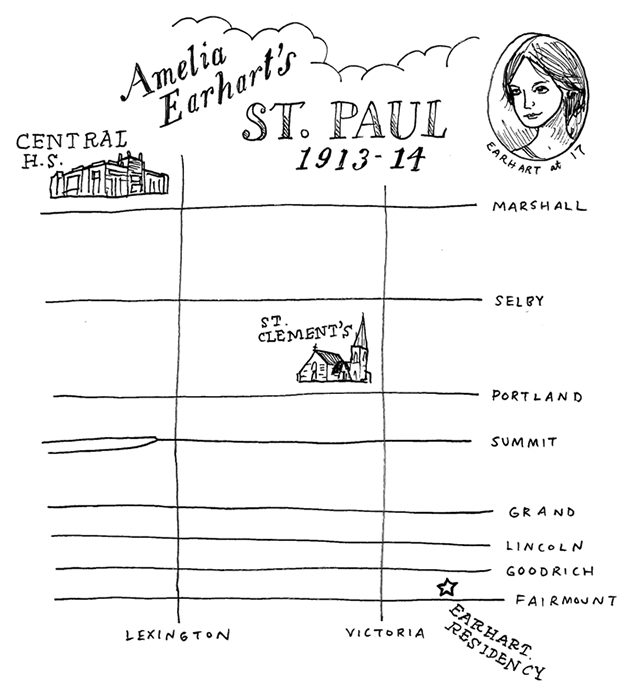
The newspaper article also says she attended St. Clement’s Episcopal Church and sang in the choir as a soprano. According to Butler, “Blocked from every other social outlet, the church provided Amelia with friends and activities: she joined the Altar Guild, was a member of the Junior Auxiliary, and sang in the choir. Each Sunday she and Marion Blodgett, a student a year ahead of her at high school who lived a block away on Osceola Avenue, walked to St. Clement’s together.”19 As members of the Altar Guild, they performed all sorts of tasks, whatever was needed, though Amelia apparently was less than assiduous at times: “Marion would remember the times when what Amelia had done had to be redone by someone else. Marion would also remember how much Amelia loved singing in the choir, and that the two of them sometimes giggled so loudly they drew a reprimand.”20
While her exterior life appeared good, Amelia’s family life was still in disarray. Two critical events occurred while they were in St. Paul. One night, Amelia was packing for her father to go on a trip when she discovered a bottle of liquor hidden in his bag. As she was pouring the liquor into the sink, her father came in. He was “blazing with anger,” writes biographer John Burke. “He approached the girl with his fist raised, but Mrs. Earhart caught his arm and he subsided in abject contrition.”21 As Muriel told it, “He nearly hit Amelia, and he had never done such a thing.”22
The girls were not involved in the holiday social events of St. Paul, but looked forward to a Twelfth Night dance at the church. The second critical event occurred when their father was to escort them, but came home very late and drunk. They had planned to meet two boys and have them over to the house afterward for refreshments. Mary S. Lovell recounts that when Edwin arrived at home, “Muriel . . . burst into tears and retired to bed. Millie, steely-eyed and square-jawed, removed the Christmas decorations and pointedly cleared away the preparations she had made to entertain the boys.”23
Amelia Earhart never drank alcohol. In Muriel’s estimation, “the hardship and mental suffering that Amelia and I endured as adolescents made an indelible impression upon us. It serves to help explain some of Amelia’s actions and attitudes in her later life.”24
Shortly after the 1913–1914 winter, the family packed up again and went to Springfield, Missouri, where a job Edwin was promised never materialized. He returned to St. Paul and eventually moved back to Kansas, while Amy and the girls went to Chicago, where the family had close friends. Amelia graduated from Hyde Park High School in Chicago.
One can only speculate what effect Earhart’s stay in St. Paul had on her, but the city and Minnesota in general can be proud to boast her as a young resident, however briefly she was here. Her courage, fortitude, and determination have made her a role model for women around the world for more than a hundred years now.
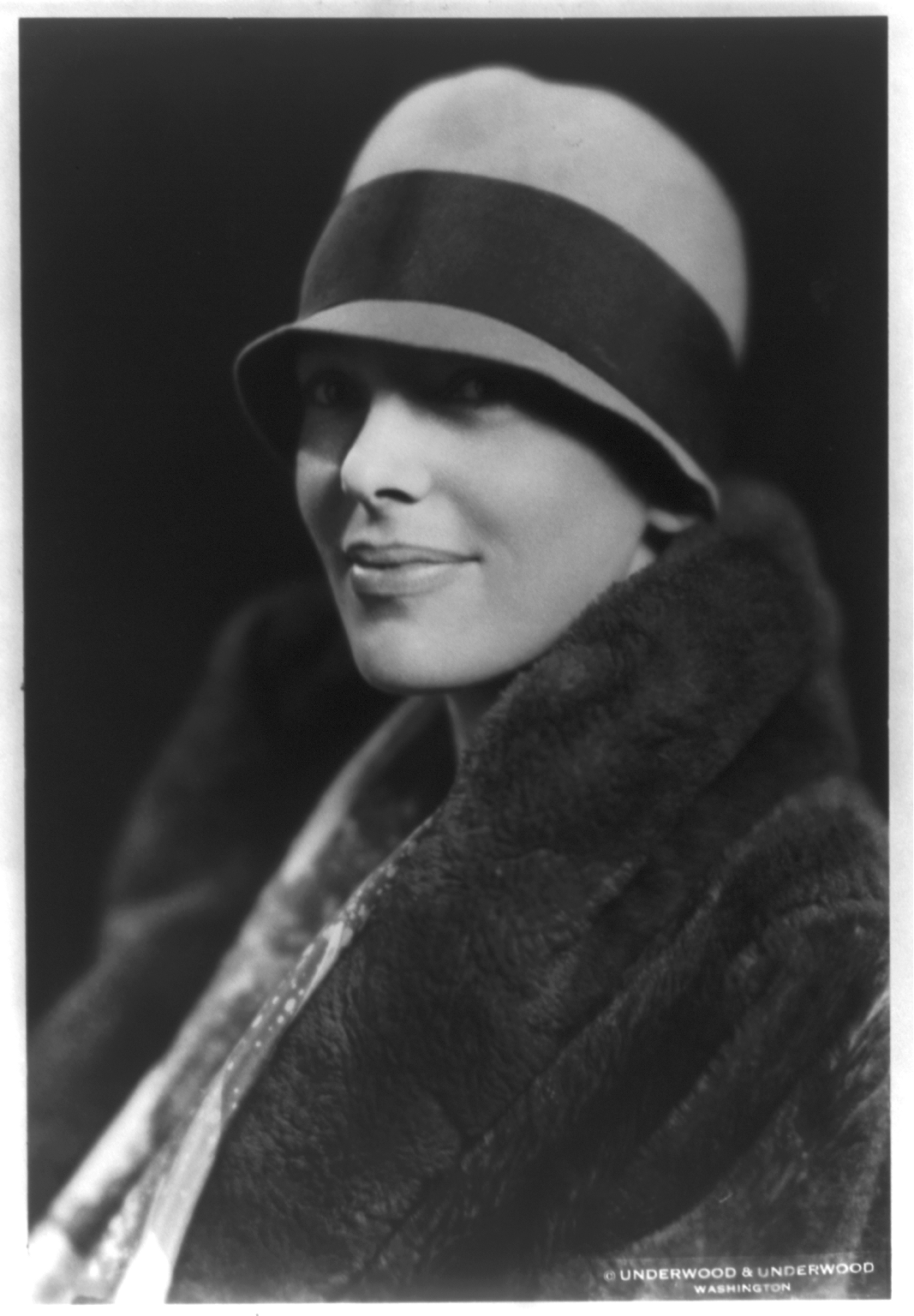
Earhart’s Honors and Achievements
Still likely the best-known female aviator in history, worldwide, Earhart’s accomplishments include:
- In 1928 she became the first female passenger to cross the Atlantic by airplane.
- In 1932 she became the first woman to make a nonstop solo transatlantic flight. For this she was awarded the Distinguished Flying Cross.
- Early in her flying career, she flew her Airster aircraft to an altitude of 14,000 feet, setting a record for female pilots on October 22, 1922. She set many other early aviation records for speed and altitude.
- She helped found the Ninety-Nines, an organization for female pilots.
- She was awarded the Legion d’honneur; she’s in the Aviation Hall of Fame as well as the Women’s Hall of Fame.
- She wrote bestselling books about her flying experiences. Since then, she has become a global cultural figure, and numerous films, documentaries, and books have recounted her life.
Part of the world’s fascination with Earhart, in addition to all her accomplishments, is the mystery of her disappearance over the Pacific Ocean on July 2, 1937, when she was attempting to become the first female pilot to circumnavigate the world.

Current Search Efforts
This October, a new expedition will be searching for the remains of Earhart’s crash in Nikamaruro, a remote Pacific Island. Though theories about her disappearance abound, the prevailing hypothesis among scholars is that her plane crashed and she made it to this island before perishing there along with her copilot Fred Noonan. The expedition is sponsored by the Archaeological Legacy Institute and Purdue University. Researchers are pursuing the hypothesis that “the Taraia Object, a longdebated anomaly in the island’s lagoon . . . could be part of the Lockheed Electra 10E once piloted by Earhart.”25 The article notes much skepticism from aviation historians; however, the artifacts include a woman’s shoe, a compact case, a freckle cream jar, and a medicine vial, all dating to the 1930s. Plus, analysis of bones found on the island in 1940 indicated Earhart’s bone lengths were more similar to the discovered bones than those of ninety-nine percent of people in general.26
Time will tell whether this decades-old mystery will be solved. Watch for news of the expedition this fall.
Lisa Heinrich is a professor emerita of mass communications at St. Cloud State University. Her consulting work has included editing, teaching writing, writing articles for magazines and newspapers, and translating/interpreting. Heinrich holds a master’s degree in English literature from the University of Minnesota and a master’s and PhD in Russian literature, history, and linguistics from Vanderbilt University. Her writing on local history and travel has appeared in the Villager, the St. Paul Pioneer Press, and on her blog, lisastories.com.
Previous versions of this piece were published in the Villager as well as lisastories.com; the author retains copyright for all.
Notes
- Muriel E. Morrissey and Carol L. Osborne, Amelia, My Courageous Sister: Biography of Amelia Earhart: True Facts About Her Disappearance (Osborne Publisher, 1987), 7.
- Susan Butler, East to the Dawn: The Life of Amelia Earhart (Da Capo Press, 1997), 49.
- Morrissey and Osborne, Amelia, My Courageous Sister, 28.
- Butler, East to the Dawn, 49.
- Butler, East to the Dawn, 50.
- Morrissey and Osborne, Amelia, My Courageous Sister, 32.
- Donald M. Goldstein and Katherine V. Dillon, Amelia: The Centennial Biography of an Aviation Pioneer (Brassey’s, 1997), 17.
- Ibid.
- Morrissey and Osborne, Amelia, My Courageous Sister, 40.
- Doris L. Rich, Amelia Earhart: A Biography (Smithsonian Institute Press, 1989), 11.
- Butler, East to the Dawn, 62.
- Morrissey and Osborne, Amelia, My Courageous Sister, 38.
- Butler, East to the Dawn, 64.
- Morrissey and Osborne, Amelia, My Courageous Sister, 40.
- Morrissey and Osborne, Amelia, My Courageous Sister, 37.
- “Records at Central High Reveal Flier Was Above Average as Pupil.,” St. Paul Pioneer Press, May 28, 1932, 1.
- Lori Williamson, “Amelia Earhart Found in St. Paul!” Collections Up Close: Podcast and Blog, Minnesota Historical Society, June 24, 2010, https://web.archive.org/web/20120320181520/http://discussions.mnhs.org/collections/2010/06/amelia-earhart-found-in-st-paul/.
- Mary S. Lovell, The Sound of Wings: The Life of Amelia Earhart (St. Martin’s Press, 2009), 15.
- Butler, East to the Dawn, 66.
- Ibid.
- John Burke, Winged Legend: The Story of Amelia Earhart (G.P. Putnam’s Sons, 1970), 38.
- Morrissey and Osborne, Amelia, My Courageous Sister, 37.
- Lovell, The Sound of Wings, 16.
- Morrissey and Osborne, Amelia, My Courageous Sister, 32-33.
- Tim Newcomb, “After 89 Years, the Clue Leading to Amelia Earhart’s Plane May Have Surfaced. It’s Been There the Whole Time,” Popular Mechanics, June 1, 2026, https://www.popularmechanics.com/flight/a71461609/amelia-earhart-mystery-lost-plane-expedition/.
- Ibid.
- Year
- 2026
- Volume
- 61
- Issue
- 3
- Creators
- Lisa Heinrich
- Topics