
Pierce Butler in St. Paul
- Year
- 2026
- Volume
- 61
- Issue
- 1
- Creators
- Paul Nelson and James Fleming
- Topics
“Hired to Carry the Dagger”
by Paul Nelson and James Fleming
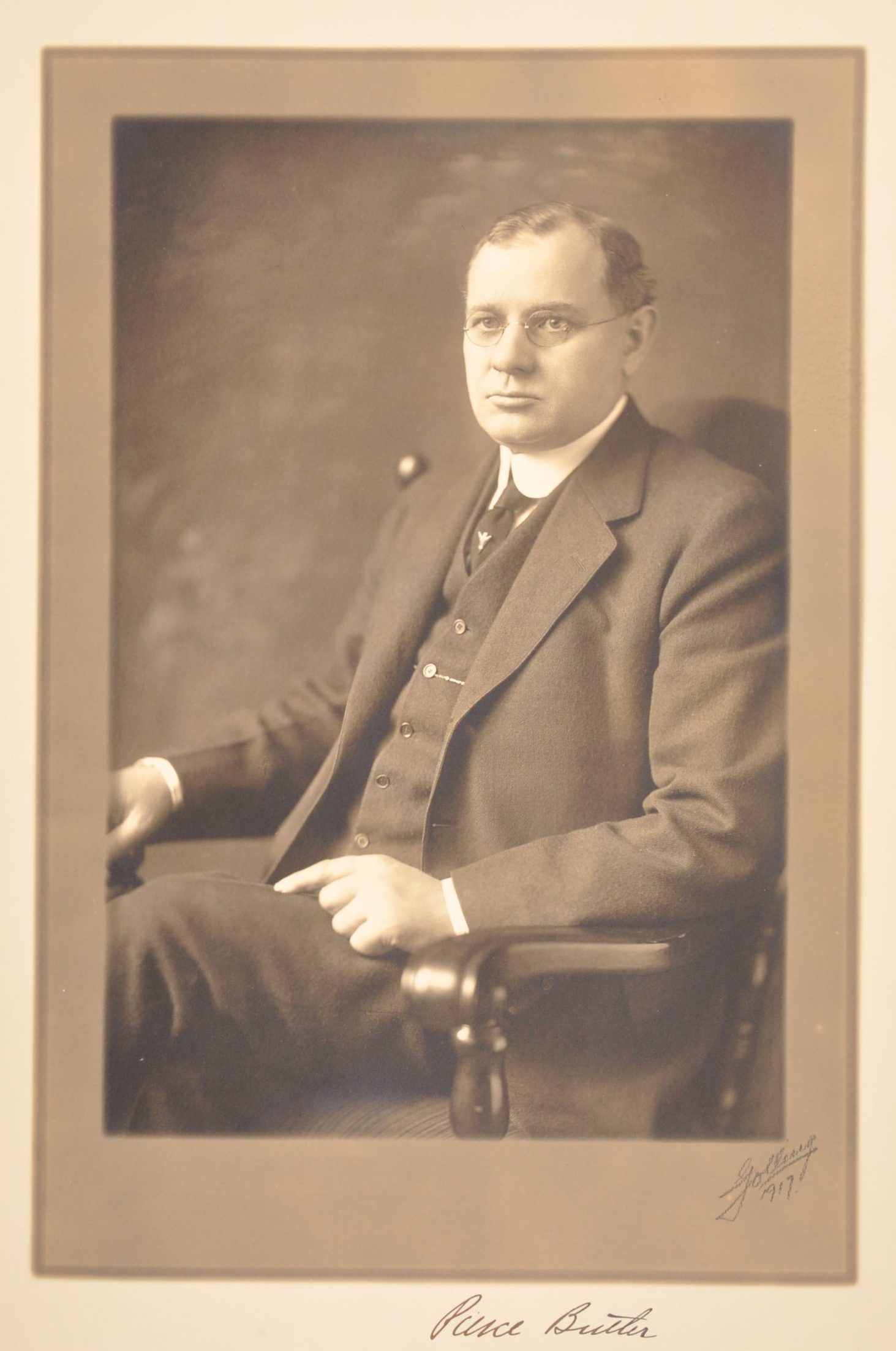
Attorney Pierce Butler could be a bully. He sometimes used his formidable powers—his intelligence, his courtroom skills, his connections, his uncompromising will, even his imposing size—against weaker adversaries, unnecessarily, unwisely, and even cruelly.
Charles Ermisch and Otto Wonnigkeit were young criminals fresh from seventeen months in the St. Cloud State Reformatory, and on a crime spree when they entered Kohlmann’s saloon, downtown St. Paul, with pistols at the ready. To their surprise, the bartender, William Lindhoff, had a pistol too. When he reached for it, they fired. Ramsey County Attorney Pierce Butler charged the pair with first-degree murder.1
Five months later, on October 19, 1894, Wonnigkeit and Ermisch died side by side at the ends of twin ropes, the only double execution in Ramsey County history. The man who made this happen was prosecutor Pierce Butler.
There were many reasons for Ermisch and Wonnigkeit to escape execution. Though Minnesota had had the death penalty, off and on, since 1849, hangings were rare. Ramsey County had not seen one since 1860. There had been a handful of first-degree murder convictions in St. Paul, but only one death sentence, commuted by the governor and thus never carried out. The people did not clamor for vengeance.2
The charge of first-degree murder against Wonnigkeit and Ermisch was an overreach. There was no evidence of premeditation—they were robbers, not killers. Wonnigkeit confessed immediately and agreed to testify against Ermisch, with, it was reported, the hope of escaping the rope—but Butler refused. Lawyers for the young men offered ample testimony that both were products of a chaotic youth, addicted to alcohol from childhood, impulsive, and probably drunk at the time of the crime. And they were very young—between nineteen and twenty.3 In nineteenth-century Minnesota, these factors were readily accepted in mitigation of the death penalty. But Pierce Butler, who himself was only twenty-eight, did not bend. His only act of mercy was to move Ermisch’s mother from jail, where she was held for trying to help her son escape, to the workhouse, so that she would not hear the sounds of her son’s execution.4
We may see Butler’s bullying tendency as a natural product of his aggressiveness, self-righteousness, and unwavering belief in his own rightness. There was more to him than that—he was public-spirited, tireless, devoutly Catholic, and a family man—but in his professional life, he was a man to be feared.
Origins
Butler was born in 1866 in a log cabin near Northfield, Minnesota. His father, Patrick, came from County Wicklow, just south of Dublin, and left for America towards the end of the potato famine, around 1852. But the Butlers weren’t among the starving. Patrick had been educated at Trinity College as an engineer, had worked for the Crown for two years, had traveled in Europe and taught English in Germany. He was an emigrant, not a refugee.
In the United States, Patrick landed in Galena, Illinois, where he met and married another Irish immigrant, Mary Anne Gaffney. They moved to Dakota County, where Patrick taught school and then acquired a farm. The cabin where Pierce, the sixth of nine children, was born was soon replaced by a more comfortable dwelling.5
By the time these Butlers arrived in what was then the Minnesota Territory, Patrick’s brother John was already in St. Paul and in the construction business; he built the first rail line between St. Paul and Minneapolis (around 1862). Young Pierce attended school in Northfield and then graduated, in 1886, from Carleton College. Unlike, say, that other log-cabin youth, Abe Lincoln, Pierce Butler grew up in a prospering family devoted to formal education. By the time he left Carleton, most of the family had moved to St. Paul and were thriving in the construction business.6
The Phenom
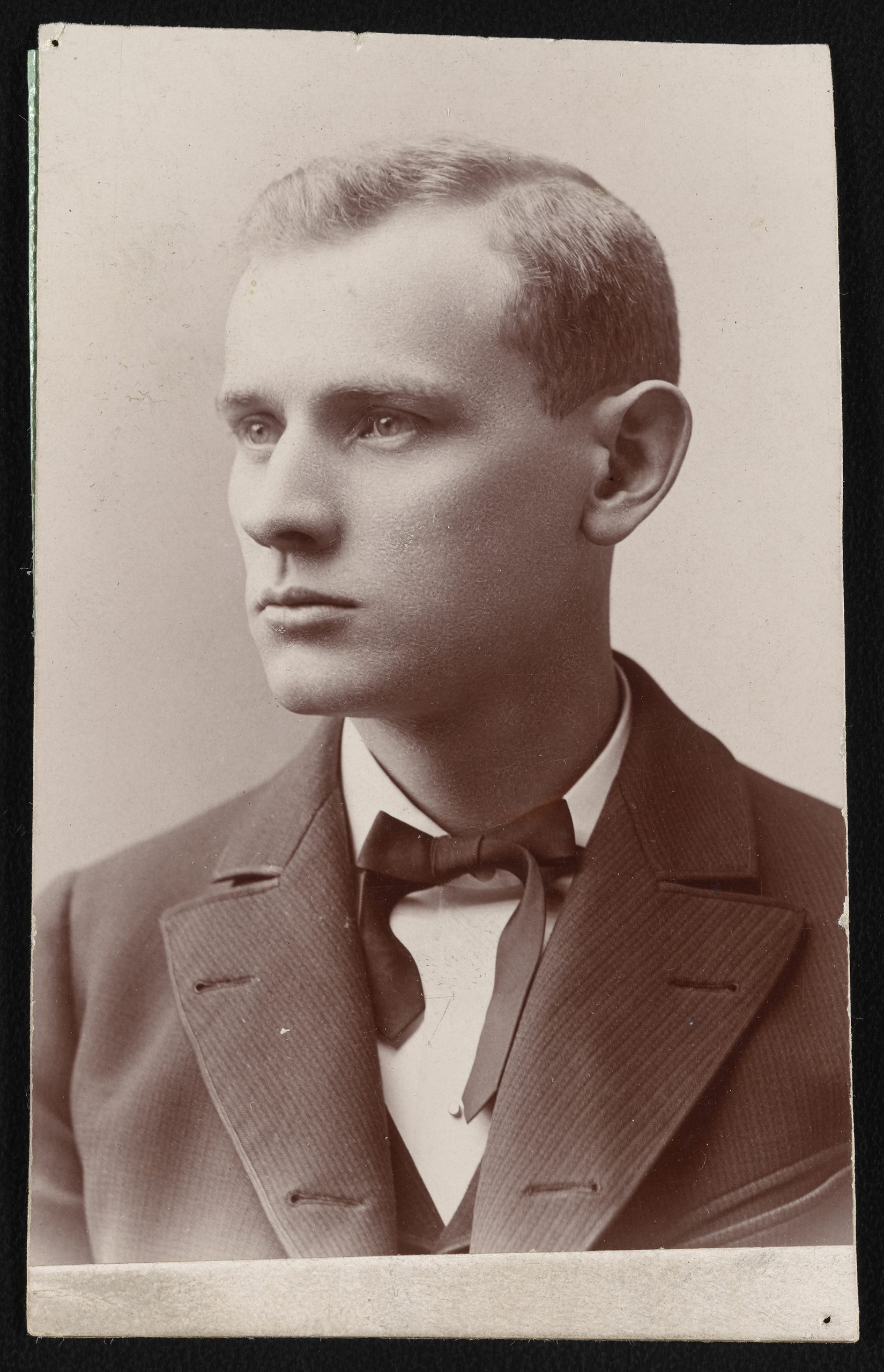
He never attended to law school: Young Butler read law for a year with a St. Paul firm, then went out on his own. In 1891, Ramsey County Attorney Thomas O’Brien appointed Butler his assistant; being Irish and well-connected helped Butler all his life. The job meant trying criminal cases and representing the county in civil matters. After two years, the voters elected him county attorney to succeed O’Brien; at age twenty-six, Pierce Butler was in charge.
As chief prosecutor, Butler decided which criminal cases to pursue in St. Paul and environs, and he was in court constantly. The variety was tremendous, from petty theft to murder, with plenty of interesting stuff in between. He tried cases of official corruption, bank robbery, sexual assault, illegal abortion, and many homicides.7 He handled all the county’s civil legal matters, including lots of wrangling with railroads—in all, priceless experience for an ambitious trial lawyer.8
Butler declined to run for reelection in 1896. In 1897, he went back into private practice, by design or happenstance specializing in bankers accused of sticky fingers—among his clients, Republican Congressman Frederick Stevens (acquitted).9 He probably also represented the various Butler business enterprises, which by this time included a host of iron mines on the Mesabi Range, as well as Butler Brothers Construction, which built the Minnesota State Capitol.10
In August of 1899, he took a job as chief counsel for the Chicago, St. Paul, Minneapolis, and Omaha Railroad, known to all as “the Omaha.”11 This was another smart career move for him: Railroads were St. Paul’s great industry of the time. The job gave him plenty of trial work, mostly outstate, fighting off the personal injury claims of the countless rail workers maimed and killed on the job. It also put him inside the complicated (and lawyer-friendly) world of the rail companies’ endless wrangles with the state and federal governments over freight and passenger rates. It was railroad work that in time propelled Butler onto the US Supreme Court.
It would also make him distrusted, even hated, in many circles. This was an era when politicians could make careers out of denouncing railroads. Every town and every farmer relied on the rails, the only reliable and year-round means of transportation. Both passenger and freight rates were intense political issues, regulated to some degree from Washington through the Interstate Commerce Commission, and locally by the state legislature and the Railroad and Warehouse Commission. Lawyers, needless to say, were everywhere.12
In politics, Butler was a Democrat, much identified publicly with William Jennings Bryan and others who railed against corporate accumulation of wealth and power. But when he went to work for the Omaha, Butler pledged his time and talents to one of the most powerful industries in the country. It got noticed. A revealing scene occurred in a trial he conducted that year in Stillwater. A farmer named Christian Abresch had sued the Omaha for causing a fire that destroyed his barns and granary.13 The plaintiff’s lawyer was a fellow St. Paul Democrat named John Willis, who said this in his closing argument: “This case is important because it is typical. A citizen standing face to face with a gigantic aggregation of capital, with its attorney hired to assassinate reputations . . . hired to carry the dagger into their scene of action.”14 The Stillwater Gazette noted wryly that both Willis and Butler had been “wont to hurl shafts at grasping corporations,” but now that Butler had gone over, “he has revised his form of expression.”15 Butler won the case. Willis, with “hired to carry the [corporate] dagger,” neatly summarized most of Pierce Butler’s career.
Butler took the lead role in what became known as the Minnesota Rate Cases, a direct attack by railroads on the power of Minnesota, and by extension any state, to regulate freight and passenger rates. The stakes were gigantic, and everyone knew the case could only be resolved at the Supreme Court. A grueling trial took place in federal court in St. Paul (at what is now the Landmark Center) that went on, or off and on, for almost three years. The nub of Pierce Butler’s argument was that Minnesota’s rates amounted to confiscation of railroad property without due process of law. Presaging his Supreme Court years defending property rights, Butler argued that government-imposed rates that guaranteed low returns were, in effect, a theft of property without compensation and thus in violation of the Constitution. He won the case at the trial court, a colossal win for the railroads. The victory, however, did not stand: Three years later he lost it at the US Supreme Court, 9-0.16
As noted, rail workers were injured and killed at an appalling rate, as the human body is no match for tons of moving metal. They and their survivors had access to the courts, but the law heavily favored the companies in three ways. First, the burden of proof was on the plaintiffs, who were often poor and needed help immediately, not whenever the courts got around to things. Second, the railroads could afford to buy the best lawyers, like Pierce Butler. Third, there was something called “the fellow servant rule,” which provided that if a worker were injured through the error of another worker, the employer wasn’t liable unless that worker were his supervisor. So if, for example, a brakeman lost a leg due to the poor training of a coworker, he could only sue the coworker—an empty and futile gesture.
Butler had seen the carnage and the resulting desperation of injured workers and their families. In 1904, he advocated doing away with the fellow servant rule. And in a major speech in 1908, he quoted the grisly figures from the previous year: 4,218 railroad workers killed, 114 of them in Minnesota (and 1,300 more injured). “No more important obligation rests upon the state than the adoption of all reasonable means to lessen the sacrifice and to insure [sic] justice to injured workmen and in case of death to those dependent upon them.”17 The implication was that the state should require railroads to spend more money on safety and recompense.
Lamenting, then, the inefficiency of the courts in handling death and injury claims, Butler advocated for the creation of a workers’ compensation system like the one we have today, a system that guaranteed compensation for injury, regardless of fault. The first steps toward making it law were introduced in the legislature shortly thereafter.18 So although Butler spent more than twenty years deeply involved in promoting the interests of railroads, and he was often portrayed as the enemy of the worker, this is not entirely the case.
This Gun’s for Hire
After six years at the Omaha, Butler went back into private practice, in the firm that would be one of St. Paul’s leading firms for the rest of the twentieth century, later called Doherty Rumble and Butler. Here, Pierce Butler earned a reputation as one of the most effective and sought-after trial lawyers in the Upper Midwest: “the dagger,” indeed. He went where the money was, yes, but also had the freedom to take the cases that interested him most.
It might have seemed strange to the people of Grand Forks, North Dakota, that the young Maie Douglas Rindlaub hired an out-of-state railroad lawyer to press for a divorce from the town’s leading physician, John Rindlaub—but evidently she wanted the toughest tough guy she could find. The trial turned into four weeks of detailed complaints dating back to the honeymoon in Europe and the Middle East, and culminated with accusations that Dr. Rindlaub was a morphine addict and a serial philanderer. It was less a trial than an airing of her endless grievances, and burdened the judge with over 5,000 pages of submissions.
Her tough guy, Pierce Butler, won Maie Rindlaub custody of the three children, child support of $75 per month (in the range of $5,000 today), a lump sum alimony of $30,000 (perhaps $5 million in today’s money), and $1,000 in attorney fees.19 But on appeal, the North Dakota Supreme Court—offended by Butler’s trial tactics—took most of it back: She lost the $30,000 and custody of two of the children. “A meritorious case,” commented Justice Fisk, “seldom requires in its preparation and support such extraordinary efforts as have been put forth by plaintiff and her counsel in this case.”20 Pierce Butler had gone too far and thus turned victory into defeat.21
Butler was a corporate lawyer, but he did not hesitate to switch sides when it might have benefited him. In the fall of 1909, the Department of Justice hired him as a special prosecutor to go up against major milling companies, under the Pure Food and Drug Act, in what came to be known as the Bleached Flour Cases.22 His involvement brought him to the attention, indirectly, of President William Howard Taft, a man who would later play a decisive role in Butler’s career.
In the flour cases, the government alleged that by bleaching wheat flour white, the millers adulterated the product with chemicals (nitrogen peroxide) that endangered the public. Butler conducted two major federal court trials, one in New Orleans in February 1910, the second in Kansas City in June. He won both, and the cases demonstrate the breadth and flexibility of Butler’s intelligence. If the railroad rate cases were all about accounting, the flour cases were about chemistry: To conduct trials of this nature, counsel has to understand. The New Orleans Times-Democrat called Butler “the pure food expert of the Attorney General’s staff.”23 The Kansas City case went to the US Supreme Court, where Butler’s work—through no fault of his—was overturned again.24
Butler’s government work got him still another high-stakes gig, this time taking on the great Chicago meatpacking houses—Swift, Armour, et al.—in an antitrust criminal prosecution in Chicago. The trial lasted four intense months, December 1911 through March 1912. The millers had been formidable foes, but pipsqueaks compared to the meatpackers.
This was a rare antitrust case aimed right at the men at the top, men named Swift and Armour, and it threatened to put them in prison. The ostensible competitors had actually formed a corporation that shared information and imposed obligations on its members to comply with common rules—in the words of the Sherman Antitrust Act, “a contract or combination in restraint of trade.” It came as a shock, then, when the jury acquitted all of them. This was Butler’s worst courtroom defeat.25
The Uncompromising Public Citizen
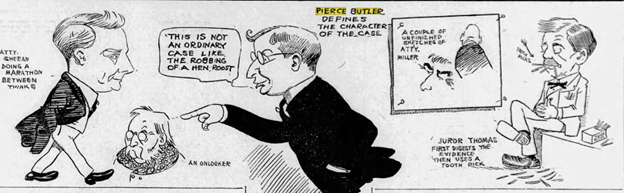
Both effective and connected, Pierce Butler was in steady demand as a speaker, a toastmaster, and on volunteer boards and commissions. The list is impressive: St. Paul Charter Commission, St. Paul Public Library Board, the Capitol Commission, the governor’s commission on reforming Minnesota courts, financing for the House of the Good Shepherd, and President of the Minnesota Bar Association.26
The position that most captured Butler’s time and attention was that of University of Minnesota Regent. He was appointed by his chum, Governor John A. Johnson, in 1907, and continued into 1923. He was instrumental in choosing three successive university presidents, instituting dormitory housing, and creating Northrop Mall.27 But it was his role as regent that brought him the most controversy and the bitterest criticism, criticism that clings to him still.
World War I brought out some of the worst impulses of Minnesotans, from ordinary citizens to state leaders. They responded to war with Germany with a long streak of intolerance and xenophobia, directed at people of German extraction and anyone tinged by political radicalism. Butler saw himself as an uncompromising patriot: During wartime, neither dissent nor doubt could be tolerated.
He had been building towards this view. In 1915, he had proclaimed this astonishing doctrine: “Allegiance [to the government] and protection are reciprocal, and, stripped of all sentiment, the one is consideration for the other—allegiance for protection and protection for allegiance.”28 Rights, in other words, are not rights at all but privileges that the citizen must earn through compliant behavior, as defined by the government.
On September 13, 1917, Professor William Schaper, chair of the university’s political science department, was summoned, on very short notice, to a meeting with the Board of Regents. Let us set the scene. The regents were led by the board president, Fred Beal Snyder, a super-patriot and head of the Minneapolis branch of the state’s vengeful and all-powerful Commission of Public Safety. Butler, one of the most feared cross-examiners in the courtrooms of the United States, was a friend of Snyder’s. Schaper was alone. Snyder, Butler, and the regents had an agenda; Schaper did not know what it was. The regents were prepared; Schaper was not. At the meeting he was informed, for the first time, that he had been accused of disloyalty, though no specific acts were cited and no accuser named. This was the University of Minnesota equivalent of Great Britain’s notorious Star Chamber.
Schaper admitted that he had opposed American entry into the war; he now supported the war effort, but did not boost it. This answer set Butler off:
Butler: You are the Kaiser’s man. You want the Kaiser and the Crown Prince to dominate the world, don’t you?
Schaper: That is an accusation, not a question. It is absurd . . . Mr. Butler, you assume the role of prosecuting attorney and assign me the role of prisoner at the bar. I desire to remind you that our relations are very different. I am the Professor of Political Science in this University and you, sir, are a member of the Board of Regents.29
In this way, Schaper compounded his crime by defending himself; he was fired that day. Butler, for his part, blamed Schaper: “I did not want to fire that man, but he gave me no chance to save him.”30 Thus the executioner blamed his victim.31
Snyder and Butler were completely open about what they had done. For Snyder, mere verbal support of the government could be lip service, and therefore equaled disloyalty. To teach at the university, one must “be whole-hearted in [the nation’s] cause, zealous to support its every act in this crisis.”32 Lukewarm patriots must be dismissed. Butler said: “Professor Schaper’s removal is in harmony with the present tendency to silence disloyal communities, institutions, publications, officials and individuals.”33
Butler’s venomous loyalism was on display in a prominent case that shortly followed. On August 19, 1918, a caravan of seventy-five or eighty men, led by the most prominent citizens of Luverne, Minnesota, kidnapped the politically unpopular John Meints, an unrepentant member of the leftist Nonpartisan League. He was taken to South Dakota, tarred and feathered, and told he would be hanged if he returned. When Meints sued them, they hired the leading courtroom tough guy of the region, Pierce Butler.
It was going to be a political trial. Meints was represented by Arthur LeSueur, former Socialist mayor of Minot, North Dakota, and secretary of the Minnesota branch of the Nonpartisan League. LeSueur’s career had been of the windmill-tilting variety, taking on big business for the injured and aggrieved and fighting capitalism.
Trial began the first week of November 1919, before Judge Wilbur Booth in Mankato. Meints’s case was conceptually simple and well rooted in the common law: The defendants had kidnapped and hurt him—false imprisonment and battery.
In Meints’s testimony:
They took me out on the prairie and stripped my clothes off. Then they tarred and feathered me. Standing there in the moonlight, facing the muzzle of a shotgun, I felt the sting of the lash on my naked back. I counted the blows—one, two, three, four. I could stand it no longer; I turned to the man who was flogging me. “For God’s sake, don’t,” I cried. He stopped. The man’s mask had slipped down on his face and I was able to recognize him. He was Rev. H.W. Bedford, pastor of the Methodist church of Luverne.34
Butler’s defense was at the same time brilliant, dishonest, and deeply cynical. He did not contest the facts. His clients, led by banker Otis Huntington, had abducted Meints, but here was the twist: Meints was so notorious for his disloyalty to America that he was in constant danger; the good citizens of Luverne had taken him to South Dakota to protect him. The brilliance of Butler’s theory was that it permitted him—required him, really—to introduce evidence of Meints’s reputation for disloyalty. And Judge Booth, another super-patriot, let it all in. Thus the trial went precisely as Butler must have hoped: a contest of loyalty versus disloyalty.35
In Pierce Butler’s closing, he said, “They went out there to save his life; they went out there to warn and protect him from harm that seemed lurking in the very air. No one can conceive of a higher citizenship than this.”36 This is the sort of lie that the law protects—it’s called “zealous advocacy.” The trial lasted three weeks; the jury’s deliberations, an hour and a half. All the defendants were exonerated.37
Meints’s lawyers appealed to the Eighth Circuit Court of Appeals. That court rejected every aspect of Pierce Butler’s defense, both facts and law: “There can be no doubt that . . . [Meints] was coerced and compelled by a show of force to submit himself to the will of others, that he was unlawfully restrained of his liberty . . . and assaulted and abused, and that this was done by those who took part in it in execution of their common purpose to drive him from the State of Minnesota.”38 The court of appeals found Butler’s defense so false that the trial court should never have allowed it at all. It is difficult to imagine a more thorough and pointed rebuke than this one. In April 1922, nearly four years after the tar and the feathers, Meints and his tormentors settled for a payment of $6,000 (over $100,000 in current value).39
The Schaper and Meints cases show Butler at his worst: bullying, intolerant, overreaching, zealous without restraint, heedless of the damage done to others. He not only carried the dagger, he used it—but to what purpose?
His Politics
Butler’s record on the Supreme Court led many to see his politics as troglodytic: hyper-patriotic, pro-corporate, anti-worker, rigidly authoritarian. He has the disadvantage, from this distance in time, of having left almost nothing of his private thoughts and—if he had any—doubts. He ordered almost all of his papers burned upon his death, so we have the public record only.
The public record naturally centers around the last seventeen years of his life, his Supreme Court years. And the record looks very conservative indeed; as we shall see, Butler was one of the famous Four Horsemen of the Supreme Court, warriors against the New Deal.
But if we look further back in time, we get a different picture. When the young Pierce Butler first ran for public office, in 1892, at age twenty-six, he was endorsed both by the Ramsey County Democratic Party, and by the People’s Party—that is, the Populists, one of America’s most radical third-party movements. He endorsed the national Democratic Party candidate for president, Grover Cleveland.40
One of the most revealing documents to turn up in this investigation is a letter Butler published in the St. Paul Globe in 1899, in response to the Globe’s hypothetical: If St. Paul received an endowment of $50 million, how should it be used to make it “an ideal city”? Among his prescriptions were better public-school facilities and higher pay for teachers, a city-wide system of public libraries, and a chain of public parks from Lake Phalen to Lake Como, ultimately linked with the parks of Minneapolis. These positions were, and are, squarely in the realm of good government. But Butler didn’t stop there. He also recommended this: public ownership of the street railway system, heating, telephones, and lighting—prefiguring the Farmer-Labor Party’s socialistic “cooperative commonwealth” of thirty-five years later.41
Butler was always a Democrat. What that means has changed over time, but in 1896 and again in 1900, he actively supported William Jennings Bryan’s presidential campaigns. Bryan tried, with some success, to rally farmers everywhere, and urban workers in the Midwest and East, against big business and the hated gold standard, which kept money scarce and expensive—much to the detriment of borrowers, like farmers.42
And in the aftermath of the Spanish-American War of 1898, Butler stood firmly with Bryan in opposition to American imperialism. He said, “The people of Cuba and Puerto Rico did not ask for government by the United States. . . . The people . . . in the Philippines have not requested the United States to establish a military despotism in the islands. . . . It is unjustifiable and dishonest to seize the islands and set up a government there. This talk of President McKinley about the higher civilization is all hypocrisy.”43 But one has to wonder: Later, when he was hounding Warren Schaper out of a job for insufficient patriotism, did he recall his own criticism of his country at war? How much had he changed, and what had driven his turn to the right?
He never wavered from a belief that the Constitution ensured iron-clad protection of private property, but he did not believe that wealth necessarily translated to virtue. He supported some limitations on corporate power and said that business executives who broke the law should be treated as criminals, such as in the Chicago meatpacking case.
As Pierce Butler marked his fifty-sixth birthday, on St. Patrick’s Day of 1922, he could hardly have predicted that on his fifty-seventh he would be an Associate Justice of the US Supreme Court. But in some ways he was superbly qualified. He had never attended law school, and he was no scholar, but his courtroom experience was vast—immeasurably greater than, for example, any current Supreme Court justice. You won’t find anyone on the Court in 2026 who has tried both sides of murder cases, won and lost elections,44 tried divorces and personal injury cases, and handled complex regulatory matters. Butler had more on-the-ground legal experience than all the members of today’s Court combined.
We shall see in part two of this article, forthcoming in the next issue of Ramsey County History, how the qualities Butler developed in St. Paul, as lawyer and citizen, played out as a Justice of the United States Supreme Court. He carried the dagger there too.
Paul Nelson is an amateur historian, the author of Fredrick L. McGhee: A Life on the Color Line 1861-1912, and many articles of Minnesota history published in Ramsey County History, Minnesota History, MNopedia, and other publications.
James Fleming was a practicing Minnesota attorney for thirty-six years. His practice included trial work in both criminal and civil matters. Fleming is a Board Member of the Ramsey County Historical Society and serves on the Editorial Board of this publication. Fleming was the Chief Public Defender in Ramsey County before his retirement in 2022.
NOTES
- Janice R. Quick, “The Crimes and Times of Wonnigkeit and Ermisch,” Ramsey County History 43, no. 1 (2008), 21-27.
- John D. Bessler, A Legacy of Violence: Lynch Mobs and Executions in Minnesota (University of Minnesota Press, 2003). Before Ermisch and Wonnigkeit, only two people had been executed in Ramsey County, the Dakota man U-Ha-Zy in 1854 and Ann Bilansky in 1860; both had been controversial.
- “Murder in the First Degree,” St. Paul Globe, June 28, 1894, 2.
- “Their Necks In Peril,” St. Paul Globe, June 29, 1894, 2; “Death Is Their Doom,” St. Paul Daily Globe, September 9, 1894, 1 (Wonnigkeit’s confession to avoid death; Butler’s refusal); “Doomed by Her Son,” St. Paul Daily Globe, October 9, 1894, 2 (Ermisch’s mother sent to workhouse).
- David J. Danelski, A Supreme Court Justice Is Appointed (Random House, 1964), 4-5.
- “Laid First Iron Rails,” St. Paul Globe, November 18, 1900, 3.
- Butler prosecuted, or assisted in prosecuting, at least nine homicide cases in addition to that of Ermisch and Wonnigkeit: Annie Smith and Kate Davis in 1892; Dr. Thomas Pearce and Phil Rice in 1893; Henry Johnson, Phil Rice (again), Gelsemino Modiano, and Charles Leonard, all in 1894, Charles Lowe and Dr. John F. Johnson in 1895. “With Willful Murder,” St. Paul Globe, July 7, 1892, 2 (Smith); “The Davis Trial,” St. Paul Globe, March 25, 1892, 2 (Davis); “Terrible Tale Told,” St. Paul Globe, March 10, 1893, 3 (Pearce); “One Discharged, One Held,” St. Paul Sunday Globe, November 19, 1893, 3 (Rice); “Rollins Murder Case,” St. Paul Globe, March 15, 1894, 9 (Johnson); “Story of the Murder,” St. Paul Globe, March 21, 1894, 4 (Modiano); “Leonard a Free Man,” St. Paul Globe, December 20, 1894, 1 (Leonard); “St. Paul,” The Irish Standard, November 9, 1895, 6 (Lowe); “Could Both Do It?” St. Paul Globe, December 4, 1895, 2 (John Johnson).
- Danelski, 8-10.
- In 1897 alone, Butler represented bankers Charles Zschau, “Zschau Is Settled,” St. Paul Globe, June 30, 1897, 2; George Jackson, “Zschau’s Examination,” St. Paul Globe, June 8, 1897, 2; W.F. Bickel, “Bickel and Brown,” St. Paul Globe, October 12, 1897, 2; and Stevens, “Fred Stevens Not Guilty,” St. Paul Globe, June 11, 1897, 1—all charged with theft of one sort or another.
- Mary Palcich Keyes, “Butler Brothers Left Their Mark on Minnesota,” Mesabi Tribune, January 23, 2021.
- Danelski, 9.
- “Railroad and Warehouse Commission,” Minnesota Legislative Reference Library, updated June 1, 2017, https://www.lrl.mn.gov/agencies/detail?AgencyID=2078.
- “Stillwater,” St. Paul Globe, December 9, 1899, 3.
- “The ‘Retort Churlish,’ ” Stillwater Daily Gazette, December 8, 1899, 4.
- “The ‘Retort Churlish.’ ”
- George F. Authier, “State Rail Rate Law Is Declared Invalid; Fight Is Mapped Out,” Minneapolis Tribune, April 9, 1911, 1; Shepard v. Northern Pacific Railway Co., 184 Fed. 765 (D. Minn. 1911); The Minnesota Rate Cases, 230 U.S. 352 (1913).
- “Liability Law the Subject of Discussion,” Duluth Evening Herald, August 14, 1908, 6.
- “Lawyers of St. Paul Discuss Labor Problem,” St. Paul Globe, January 24, 1904, 9; “Move to End Personal Injury Litigation is Object of Proposed Law,” Duluth Evening Herald, January 25, 1909, 1.
- “Complete Decision of the Supreme Court in the Rindlaub Divorce,” Fargo Forum and Daily Republican, February 1, 1910, 5.
- Rindlaub v. Rindlaub, 19 N.D. 352, 125 N.W. 479 (1910), quotation at 395.
- “Sensational Divorce,” Duluth Evening Herald, February 4, 1908, 5; “Long Drawn Out Sensational Case,” Grand Forks Herald, February 4, 1908, 8.
- “Celebrated Bleached Flour Case To Be Tried Today In Federal Court,” New Orleans Times-Democrat, February 10, 1910, 4.
- “Celebrated Bleached Flour Case.”
- United States v. Lexington Mill & Elevator Co., 232 U.S. 399 (1914).
- “Packers’ Fate Hangs on Judge’s Ruling on U.S. Evidence to-Day, Defense Forces Crisis by Questioning Proof of Conspiracy,” Chicago Examiner, January 10, 1912, 9; “Packers Free, Plan to End National Co.,” Chicago Tribune, March 27, 1912, 1.
- “Judges in Move to Stop Law’s Delay,” Minneapolis Tribune, December 12, 1912, 2 (governor’s commission); “To Make a Charter,” St. Paul Globe, August 6, 1897, 8 (Charter Commission); “It Is Deeply in Debt,” St. Paul Globe, July 28, 1900, 3 (Library Board); “Name New Capitol Commission,” Minneapolis Journal, February 10, 1906, 8 (Capitol Commission); “Plan to Aid House of Good Shepherd,” St. Paul Globe, August 24, 1904, 3 (House of Good Shepherd); “Banquet Finishes Lawyers’ Convention,” Duluth News Tribune, August 16, 1908, 2 (State Bar president).
- “News in Minnesota,” Little Falls Herald, June 21, 1907, 6 (appointment); “Economy Rules Regents’ Plans,” Minneapolis Journal, May 17, 1908, 5 (on Regents’ executive committee); “Beautiful New Campus Encompassed in New Plan Adopted by ‘U’ Regents,” Minneapolis Tribune, June 11, 1908, 8; “Hill for President,” Kenyon News, August 31, 1910, 7 (on presidential search committee); “Regents Look for Successor,” Daily Post and Record, December 12, 1916, 5 (on search committee, again); “Dormitory Plan for University Men Advocated,” Minneapolis Tribune, November 25, 1920, 19.
- “Educating for Citizenship,” The Catholic Bulletin. August 7, 1915, 1.
- Danelski, 102.
- Danelski, 17.
- Danelski, 100-103.
- “More ‘U’ Faculty Men Questioned by Board on Patriotism Stance,” Minneapolis Tribune, September 15, 1917, 18.
- “War Obstructors on ‘U’ Faculty to Lose Jobs, Says President of Board,” Minneapolis Journal, September 14, 1917, 1.
- “Meints’ Suits Brought to Aid Non-Partisan League,” Rock County Herald, November 28, 1921, 12.
- Meints v. Huntington, 276 F. 245 (8th Cir. 1921).
- “Defendants Win Deportation Case in Court,” Daily People’s Press, November 16, 1919, 1.
- “Defendants Win Deportation Case,” Daily People’s Press.
- Meints v. Huntington, 276 F. 245 (8th Cir. 1921).
- “Rock County Man Settles $100,000 War Time Suit Out of Court for $6,000,” Minneapolis Morning Tribune, April 23, 1919, 10.
- “The Fourth District,” St. Paul Globe, March 30, 1892, 1.
- “A Chain of Parks,” St. Paul Globe, May 14, 1899, 7.
- Michael Kazin, A Godly Hero, the Life of William Jennings Bryan (Knopf, 2006), 82-103.
- “Star of Empire Dim,” St. Paul Globe, December 18, 1898, 5.
- “Minnesota Legislature Opens Biennial Session,” Minneapolis Tribune, January 9, 1907, 1; “Hackney-Butler Contest,” Peoples Press, February 8, 1907, 5.
- Year
- 2026
- Volume
- 61
- Issue
- 1
- Creators
- Paul Nelson and James Fleming
- Topics