
Myth, Memory, and the Origins of the St. Paul Jewish Community Center Symphony Orchestra
- Year
- 2026
- Volume
- 61
- Issue
- 1
- Creators
- Kate Dietrick
- Topics
“Under Lisowsky’s Baton”
by Kate Dietrick
Discordant Origins
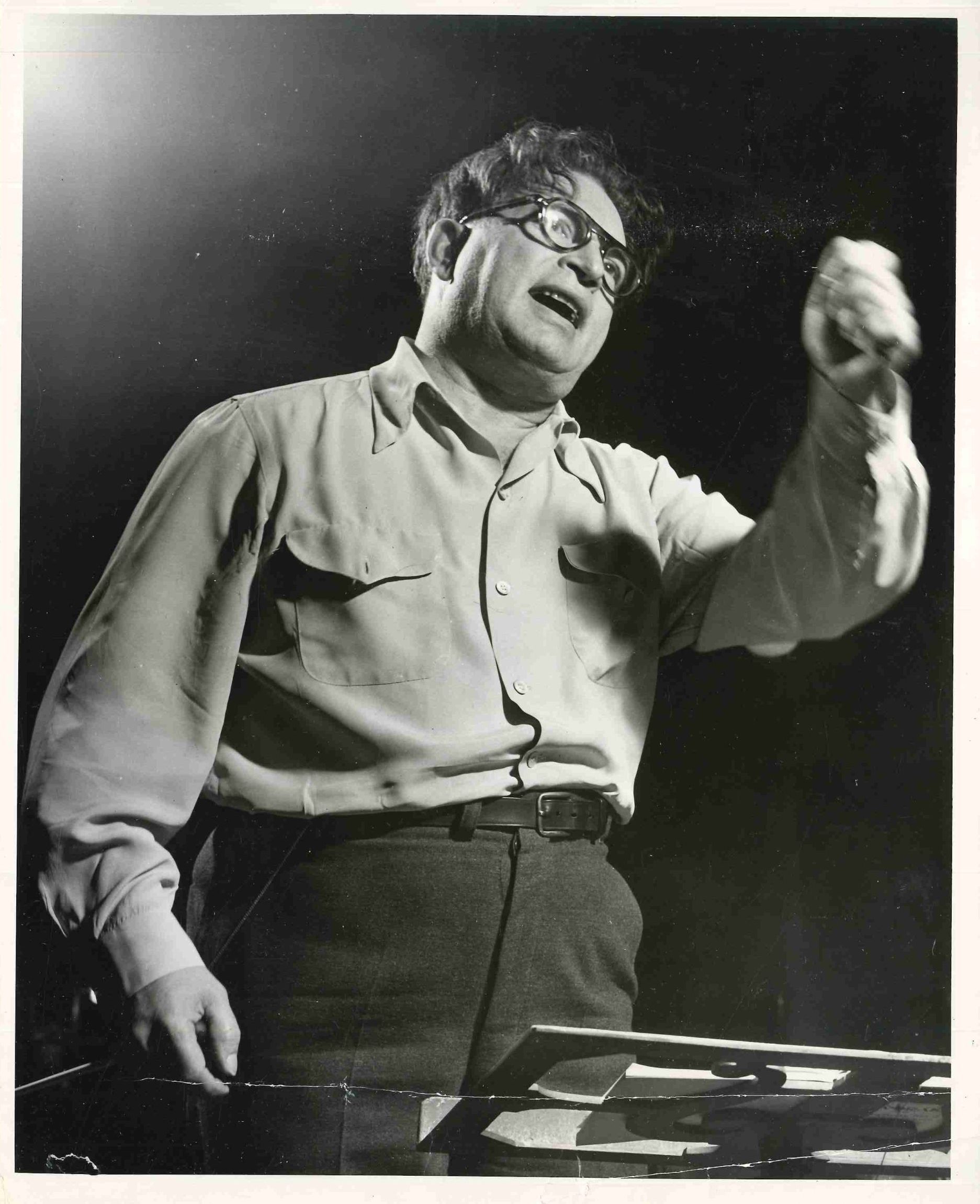
Two slight taps . . . the lifting of a baton . . . the hushed tenseness of sixty faces revealing differences in age, sex, background, in everything but their common love of fine music and in the present waiting upon their master . . . and thus is ushered in on this fourteenth day of September 1942, the tenth historical season of one of the most unique institutions in St. Paul, the Center Symphony Orchestra.1
Thus reads publicity describing the dynamic community symphony orchestra hosted at the Jewish Community Center (JCC) in St. Paul. The group, now known as the Minnesota JCC Symphony Orchestra, is still in existence and is billed as one of the oldest community orchestras in the country as they close in on their one-hundred-year anniversary.2 Upon researching their storied history, however, that centennial commemoration year became a bit atonal. A simple question arose: When was the orchestra founded?
In the publicity statement quoted above, they stated that they were celebrating their tenth historical season in 1942, which would point to having been established in 1932. However, that same publicity document continues, “As a matter of record, however, this orchestra has really long ago celebrated its tenth anniversary, for it was exactly seventeen years ago that Mr. Peter Lisowsky, its director from that time to the present day, called together a group of enthusiasts in the old St. Paul Musicians’ Hall.”3 That would then suggest that the orchestra was established in 1925.
Beginnings can sometimes be tricky, and myths cloud early origins. Institutions may start informally, or lose early establishing documents, or forget early history, and some may start and stop and start up again. So it is not unique that the early years of the orchestra are somewhat hazy. While researching in the archives, I came across several founding years. The aforementioned document noted both 1925 and 1932 as important starts. But if the St. Paul JCC, where the group began, only opened in 1930,4 was their orchestra established in 1930? But if in 1988 they were celebrating their sixtieth season, were they established in 1928? Yet another article states that they’ve had a long, consistent history since 1933, while still another states that the first annual concert was in 1934.
So when, in fact, was the orchestra started, and could this humble local group claim the title of oldest community orchestra in the country? The answer, of course, depends on which narrative you believe. The shifting timeline of beginnings can be attributed to one thing: the pull of enigmatic long-time conductor Peter Lisowsky.
A Home at the Center
Over its long history, one thing has been static: The community symphony orchestra, made up of non-professional players, was rooted in place at the St. Paul Jewish Community Center. Jewish community centers, such as the ones founded in St. Paul and in Minneapolis that still thrive today, began as a place for the educational, social, cultural, and recreational lives of Jewish immigrants. Financial support was available for those in need, thanks to Jewish social service organizations, such as Neighborhood House, and other benevolent groups who helped struggling families and new immigrants gain their footing in St. Paul.5
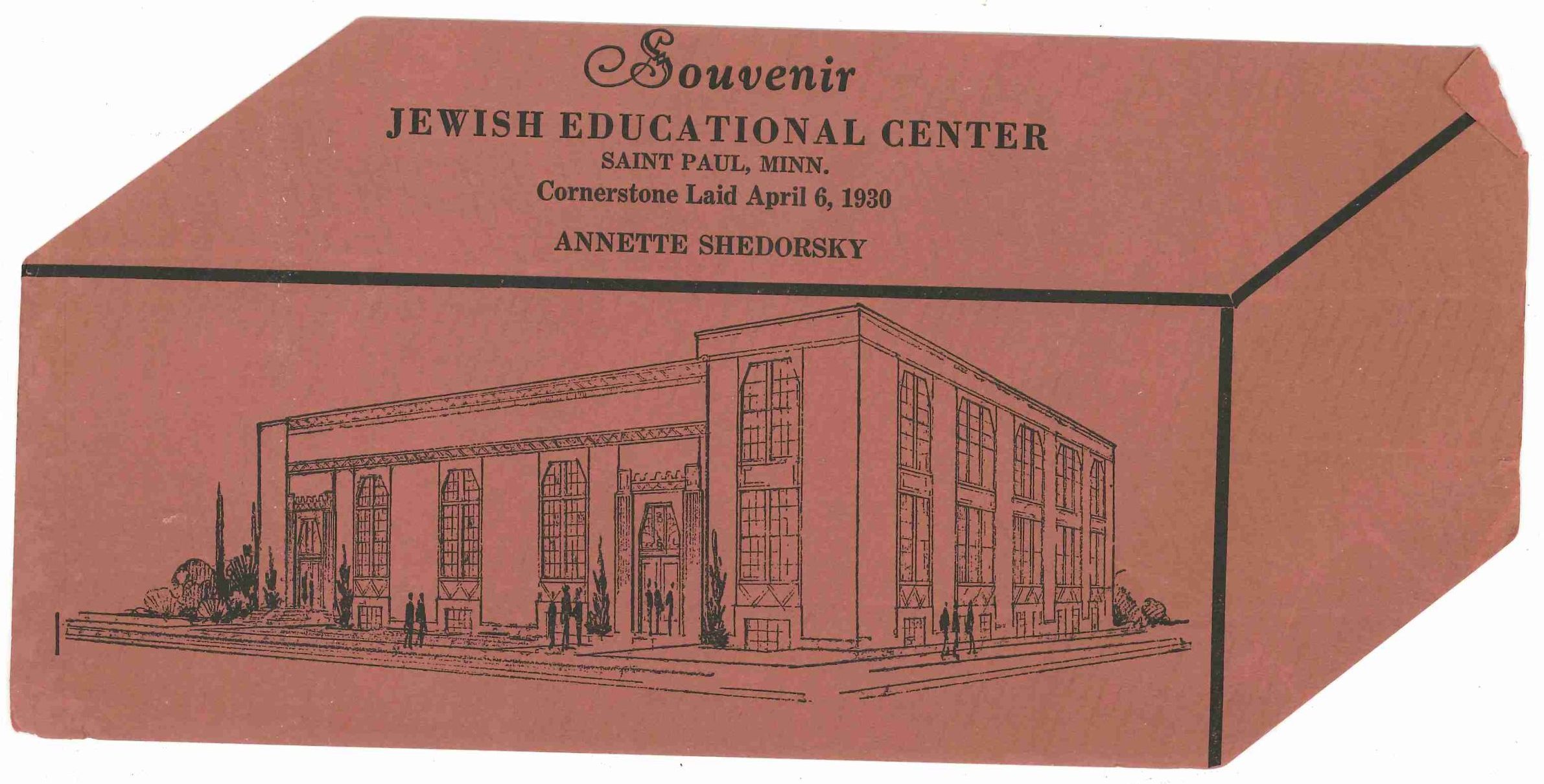
But outside of synagogues, there was no one social gathering space for the growing Jewish population. After years of campaigning and fundraising, in September 1930, the Jewish Education Center opened at the intersection of Holly Street and Grotto Avenue in the Summit Hill neighborhood. The space was originally called the Jewish Education Center, or JEC, because not only was it to be a social meeting space for the community at large, but it also housed the Talmud Torah, educating the next generation of Jewish children.6
In the JEC dedication brochure, Rabbi Harry Margolis of Mount Zion Temple in St. Paul extolls the value of the new space: “It stands as a house of learning; it stands as a Beth Ha K’neseth, a meeting place for the community.”7 From the outset, the Center was touted as a meeting place for cultural activities, one of which was a community orchestra. On December 16, 1930, not even three months after the Center’s dedication event, a report details the process of organizing a junior orchestra.8
On February 2, 1931, a letter was sent to the American Jewish World, a local Twin Cities Jewish newspaper, requesting that they publish an invitation from the JEC to anyone interested in taking part in junior and senior orchestras. “Old and young—men, women and children—playing any kind of an instrument are urged to come. The player of jazz music or of classical music will be equally welcomed.”9 A mailer announcement that went out the following week listed that the orchestras were organized by Melvin Silver and George Rosen, and noted succinctly, “Come without fail. We need you.”10 This early group, founded in 1931, is technically the beginning of the symphony orchestra at the JEC.
Later meeting minutes share the progress of those early years, noting “the senior orchestra was organized in February 1931 with 25 members. Mr. Dave Nahinsky is director”—clearly an entirely different director than who was listed in the first mailer invitations. It continues that the “junior orchestra was organized February 17th, 1931, with 15 members.” Both the junior and senior orchestras are noted as lacking brass and woodwinds, but that they remained hopeful “in the next season to fill these vacant sections.”11
On January 12, 1932, the executive secretary’s report is frank: “The Hazomir [chorus] and orchestra have been rehearsing regularly, but show small attendance. Their advisers are not giving them the attention needed.”12 By April 1, 1932, the newspaper for the JEC notes on the front page: “Orchestra Seeks Active Members.” “Approximately one year ago when the Center orchestra was organized, a large number of enthusiastic musicians made their appearance. Since that time regular membership has dwindled to about 15 members . . . new members are invited to join this organization.”13 Alas, a document outlining cultural activities in the 1930/31 season tells us the eventual fate: “orchestra—lacked organization and disbanded early this spring.”14
Only a few months later, in a report on December 15, 1932, the orchestra phoenix rises from the ashes: “We have been fortunate in getting Peter Lisowsky, first violinist with the Minneapolis Symphony orchestra, to direct a Center orchestra. Mr. Lisowsky has been holding rehearsals every week and this group shows promise of becoming a very fine musical organization.”15 Only one year later, the orchestra was flourishing, and a 1933 annual report read, “To Mr. Peter Lisowsky, I extend my humble words of thanks for his ardent and assiduous efforts in giving us an orchestra that surpassed any we have ever had at this Center. It is with a feeling of pride as chairman of this division that I extend my thanks to his musical mates and himself for this good work.”16 So who was Peter Lisowsky, this man who swooped in and saved the Center orchestra in 1932?
The Pull of Peter Lisowsky
Peter Lisowsky was born June 26, 189317 in St. Paul, Minnesota. His life-long dedication to music began when he was nine years old, taking violin lessons from Daniel Muhlenbruch, the director of the St. Paul Metropolitan Opera Company. Lisowsky enrolled at the St. Paul College of Music, and later studied in Boston, New York, and Stockholm.18 A stint studying under a famous Russian violinist, coupled with a foreign-sounding last name, had Lisowsky billed as hailing from Russia during his early years performing. Or perhaps “The Russian Violinist” was simply better branding than being St. Paul-born and bred.19
Lisowsky played in symphony orchestras in New York and Minneapolis, where he was first violinist and soloist. When World War I broke out, he served in the US Navy, where he conducted the Naval Training Center Orchestra. This proved to be “a serious turning point in his musical career,”20 as he found he enjoyed conducting as well as performing. After the war, he returned to Minnesota to perform with the Minneapolis Symphony while also giving private lessons to supplement his income.21 The latter profession appears to have led him to his love.
Details of his first, short-lived marriage to a Swedish woman named Anna remain opaque;22 rather, it was his second marriage to fellow musician Agnes Thro in which he formed a partnership that lasted a lifetime. Their love letters, sent while Lisowsky was traveling with the Minneapolis Symphony, reveal a passionate love incongruent with his later persona as a gruff conductor. In a letter to Agnes on January 24, 1929, while on tour with the symphony, he wrote: “Puddie, I miss you so much, that time is beginning to hang heavy, on my hands. Babe, I must confess that to live without you is futile. . . . Darling, I have many plans and ideas that we must carry out to the letter, after seeing life all around me, both in the orchestra and otherwise.”23
Six months later, Lisowsky wrote a letter to the Secretary of the State Board of Law Examiners complaining that his attorney was not moving quickly enough to get him out of his first marriage.24 Clearly successful, by the following year, Peter and Agnes were married. A Minneapolis Star Tribune article featuring a then-ninety-seven-year-old Agnes Lisowsky notes that, when they got married in 1930, “Peter was Jewish, and her Catholic family wouldn’t speak to her for years.”25 Regardless, their marriage was filled with music from the start.
How and why Lisowsky began his orchestra and relationship with the St. Paul Jewish Education Center remains hazy. At some point—one article says 1933, another 1928, even another in 192526—while Lisowsky was still with the Minneapolis Symphony, he had desired to return to conducting. He began the St. Paul Junior Symphony, which met at the Musician’s Union Hall, then the Dyer Brothers Music Building.27 When Lisowsky began his role with the Center in late 1932, it appears that he brought this group of musicians with him to the Center, thereafter known as the Center Symphony Orchestra. This is likely where the confusion of the founding year arises: Can those early years of Lisowsky’s St. Paul Junior Symphony be rolled into the beginnings of the Center’s orchestra?
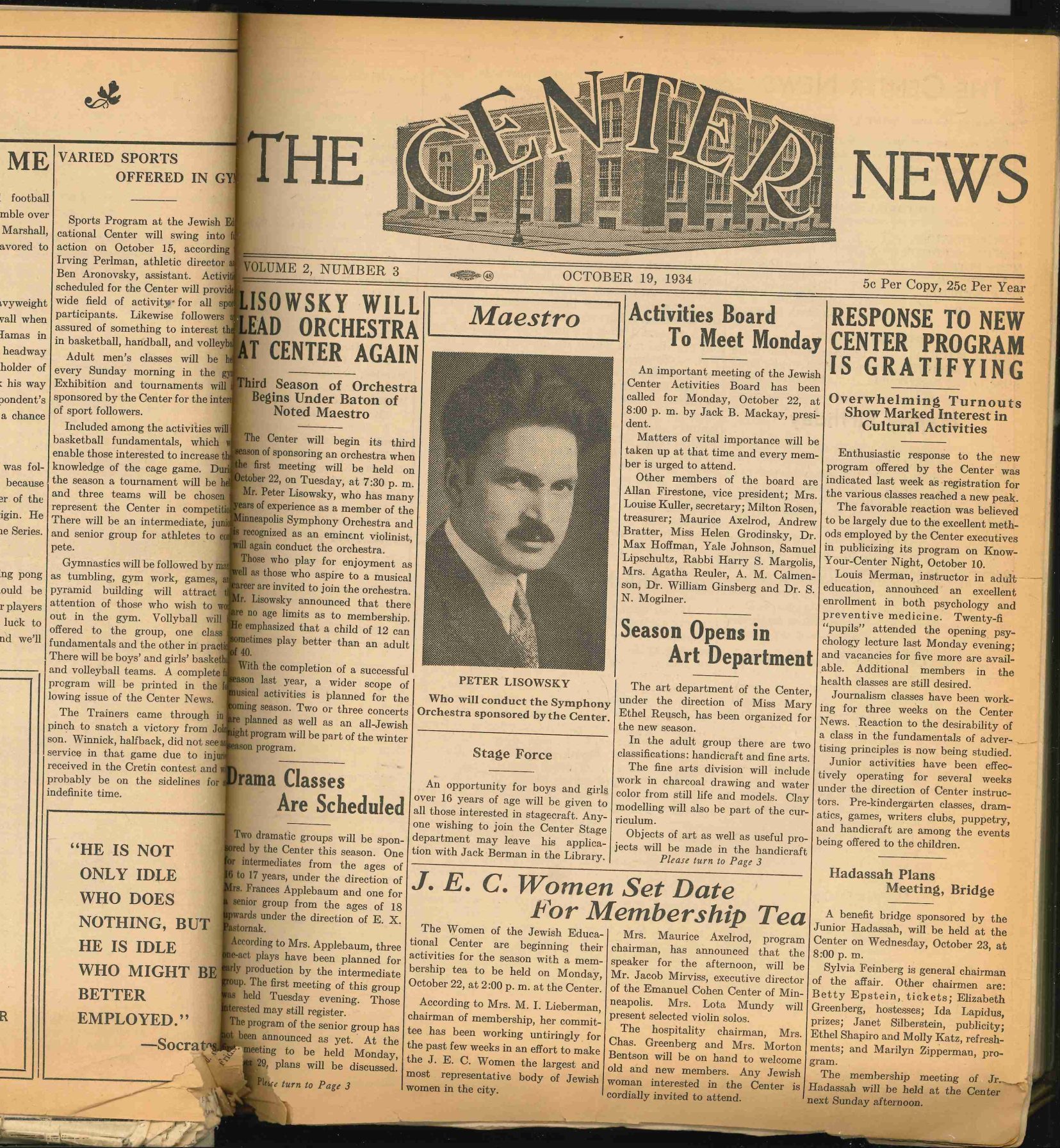
What we do know is that Lisowsky began the orchestra at the Center in late 1932.28 By October 1934, we see his photograph on the front page of The Center News with the headline “Lisowsky Will Lead Orchestra at Center Again.” It goes on: “The Center will begin its third season of sponsoring an orchestra”—which means this timeline of the Center orchestra only starts with Lisowsky’s tenure and does not count the group’s 1931 and 1932 years under other leadership, nor does it roll in Lisowsky’s earlier group history. “Mr. Peter Lisowsky, who has many years of experience as a member of the Minneapolis Symphony Orchestra and is recognized as an eminent violinist, will again conduct the orchestra. . . . With the completion of a successful last year, a wider scope of musical activities is planned for the coming season. Two or three concerts are planned as well as an all-Jewish night program will be part of the winter season program.”29 A 1935 report notes that the group started out small: There were “13 men and 8 girls” and average attendance was seventeen.30
Again, in 1936, a report extolled Lisowsky’s virtues:
Another volunteer who deserves praise is Peter Lisowsky, who has directed the Center orchestra. As far as I have been able to determine, ours is the only Center in the country that can boast of a symphony orchestra. Mr. Lisowsky has rehearsed once a week regularly with some thirty musicians and two weeks ago presented a concert for an audience of five hundred. The enthusiastic response given the performance is an adequate expression of its place in the community. Mr. Lisowsky needs no introduction as one of the leading musical artists in this city. The orchestra is a worthwhile activity to maintain, particularly when we are able to have someone like Mr. Lisowsky to encourage its success.31
By 1938, it appears that Lisowsky resigned from the Minneapolis Symphony Orchestra to devote his time entirely to conducting and teaching. He offered violin lessons for young students at his home in St. Paul, alongside his wife, who taught piano and voice.32 Lisowsky did seem to be a dedicated conductor to the group at the Center. In an undated letter, Lisowsky welcomes his colleagues in the orchestra for their first rehearsal of the year: “I believe that our work through the years in the orchestra has been enjoyable, educational; the opportunity of musical development cannot be equaled in any part of our country; the high standard that prevails both in rehearsal and the performance is a tremendous satisfaction to the members of the orchestra. The very fine feeling of friendliness that prevails also is a very important point in our non-sectarian orchestra. . . . I personally feel that you all are part of my large family, and I love you.”33 For their part, the leadership of the Center regularly praised the talent of Lisowsky and the strength—and distinctiveness—of their Center orchestra.
As Lisowsky cemented the success of the orchestra, the myth of his greatness arose. A 1966 article touched upon Lisowsky’s legacy, including his temperament, when it noted, “He has been called a task-master by some and eccentric by others, and sometimes there are strained moments. But above all, he is a true musician who deserves the respect of his players; a careful artist who wants their best.”34 Whatever his temperament, his success was evident, as Lisowsky kept the community orchestra together for many years.
“Regardless of race, creed or color”
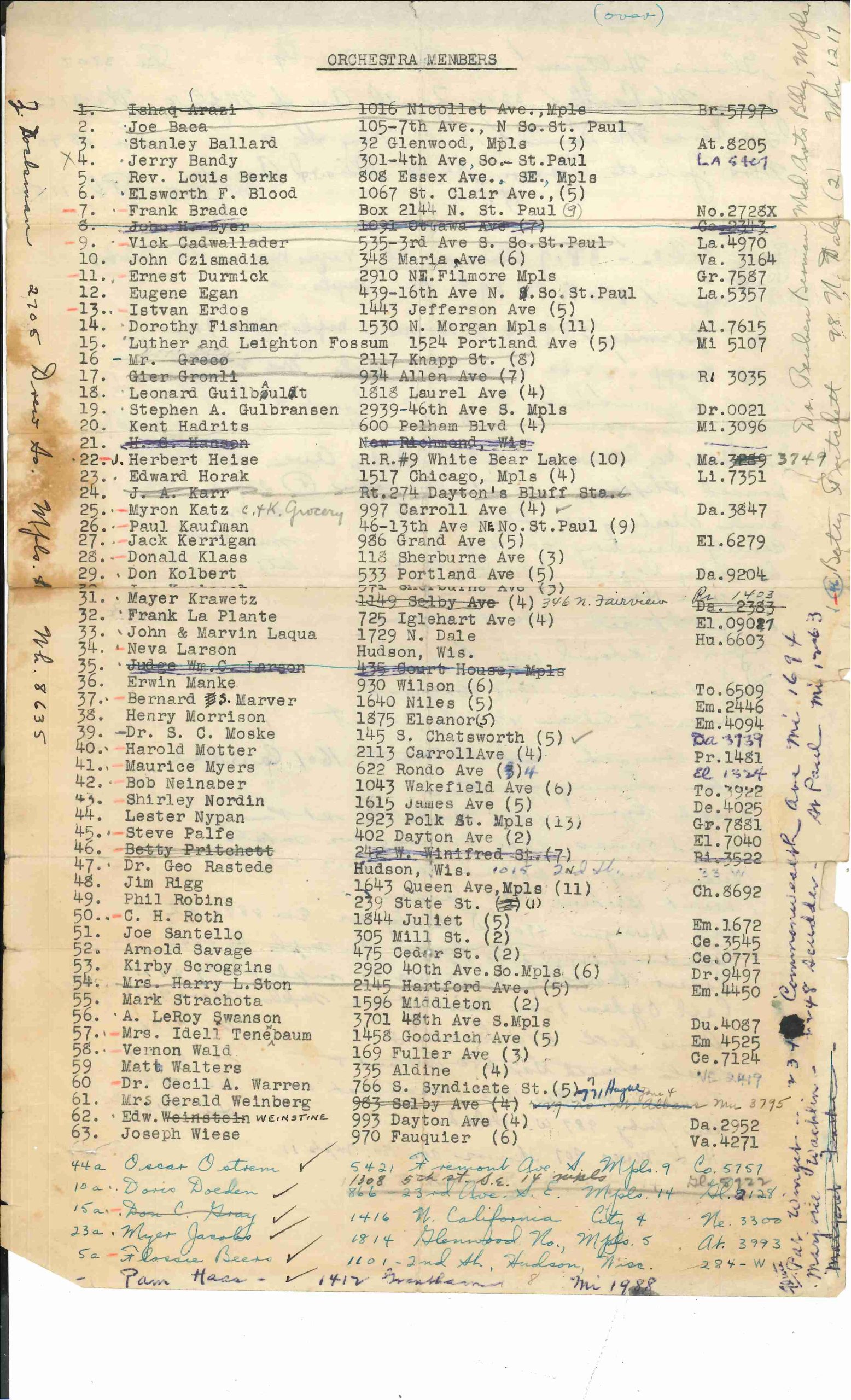
Examining the program for that 1936 concert that boasted an audience of five hundred, there are thirty-nine performers listed, with typically Jewish-sounding names like Katz and Rosenzweig. But for every Schultz, there’s also a Johnson, or a Roberts. The pieces they are playing, by composers like Mozart, Beethoven, Puccini, are not Jewish per se.35 Even though the orchestra was housed at a Jewish Community Center and was being conducted by a Jewish musician, this was not just a Jewish group. In fact, one did need not to be Jewish to join.
A 1944 Pioneer Press article noted, “Membership in the ensemble is open to every person, regardless of age or religious affiliation, who is interested in instrument playing, and who desires to acquire a standard orchestral repertoire.”36 The St. Paul Musician echoed, “Anyone in the community, regardless of race, creed or color, is very welcome.”37
Lisowsky himself was Jewish; over his career he had orchestrated several Jewish pieces, including a symphonic background for chorus of “Avinu Malkeinu,” which is a prayer recited during the Jewish high holidays. In an article in the St. Paul Jewish News years into his professional career, Lisowsky noted, “More important than the music . . . is that I think I’ve been a good will ambassador to our neighbors of other faiths. In our Center orchestra, where 75 percent of the players are non-Jewish, there has never been the least dissention over race, creed or religion.”38
That a Jewish organization was open to diverse members is not surprising. As American Jews were routinely pulled in and out of inclusion in whiteness throughout the nineteenth and twentieth centuries based on the whims of politics, many Jews themselves aligned with minority groups after experiencing decades of persecution.39 As an example of solidarity, during the civil rights movement, it is estimated that between half and three-quarters of the funds raised to support civil rights organizations came from the Jewish community, and this at a time when Jews made up less than three percent of the population of the United States.40
As the years progressed, the Center Symphony Orchestra was a point of pride for the Center. In a 1943 publicity brochure titled “It’s your Center!” they boast about the orchestra: “This activity deserves far more than the brief mention it can be given here. It represents the untiring work and devotion of Peter Lisowsky, a musician so well known to St. Paul and the Northwest that there is no need to recite his many qualifications here.” Yet again, we see the confusion over the founding years as it states, “This year the Center Symphony celebrates its tenth successful season, although in actual fact the orchestra itself is seventeen years old.” This would then put the founding back even farther, to 1925. It goes on, “Peter Lisowsky’s unselfish hard work, given for many years without any fee or salary, coupled with his professional skill, have built this orchestra until today it is favorably known in a wide area. . . . Forty to fifty persons are engaged in this activity, and it is one of several in which a good number of non-Jews take part.”41
We see this detail time and again in the literature surrounding the orchestra. A 1948 self-study on the Center: “There are thirty-five participants in the orchestra conducted by the Center, 40% of whom are non-Jews.”42 An announcement for a fundraising concert: “It is a non-sectarian group. Truly a community organization and the only one of its kind in St. Paul.”43 A press release from 1962 (which states it is in its thirtieth season, meaning founding in 1932): “Anyone in the community, regardless of race, creed or color, is very welcome.”44 This 1962 press release, with its open invitation, came notably before the Civil Rights Act, and before the march on Selma. The first racially integrated orchestra in the United States is considered to be the Symphony of the New World in New York, and they weren’t founded until 1964.45 What the actual racial makeup of the members of the Center orchestra was over the years remains murky behind enrollment lists, though it is clear that there was a Black soloist, the pianist Anthony White, as early as a 1965 concert.46 So while publicity may have stated that the orchestra was open to being racially diverse, it remains unclear as to how true this was in practice.
But the publicity push continued. A 1963 article from the St. Paul Dispatch opens with the headline “Symphony Fosters Racial Harmony.” “Racial as well as musical harmony is being created through the 48-member symphony orchestra of the St. Paul Jewish community center. ‘There has never been any friction among members of the orchestra,’ said Peter Lisowsky, the orchestra’s conductor, ‘because of differences in race or religion.’ ” The article goes on to state, “As diverse as the racial make-up of the symphony has been over the years with its polyglot membership of Jews, Irish, Mexicans, and other nationalities, it has been no less diverse in the occupations and professions of its members.” The article then launches into the wide range of professions included among the orchestra.47
It bears noting that while current framing of diversity often implies race and sexuality, diversity in the mid-twentieth century could mean something different. Class stratification, generation of immigrant status, and employment all played into concepts of diversity in this community orchestra. These were not paid professionals who might command elite paychecks, but rather people with day jobs who enjoyed playing orchestral music with a dedicated group in their downtime. As the May 18, 1956 St. Paul Dispatch article blasts under a headline of “Ph. D.’s and Businessmen Beat It Out With Bach,” “Every Monday night, housewives and businessmen, joined by two doctors of philosophy and chemistry, a physician, a dentist, an accountant, a social worker, several engineers, a jeweler, several music teachers and a few bobby-soxers, meet to make up this musical organization.”48
A 1962 article (which states the start of the organization in 1933) again points to the unique backgrounds of the members: “Peter’s eyes move on to the violinist Alfred Thom, the insurance man. Sitting in the same row—Dorothy Memmer, who sells typewriters by day, and Bernard Marver, the accountant. . . . Watching him closely in the cello section, Idell Tenenbaum, housewife and artist; Herb Heise, who works at the post office, and Edward Fishman, a German refugee with a long story.”49 Examining member lists shows many members came from St. Paul, but also some from Minneapolis, St. Louis Park, Circle Pines, and Hudson, Wisconsin. Some were students at Macalester College or even living at the Commodore Hotel in St. Paul. Attendance sheets illustrate excellent attendance across the board; many members were consistent attendees coming back every single week.50
And no wonder—the orchestra would give performances that were well received and well attended. One 1957 letter, written by the Center’s executive director, raves over a successful concert: “The concert was held at Mechanic Arts High School, to a standing-room-only audience of 1100 young boys and girls. The program was enthusiastically received. This is worthy of mention in view of current fads and tastes of young people in popular music. The audience was extremely receptive and received each one of the numbers with a tremendous ovation.”51 These “current fads and tastes” can be illustrated by the fact that the number one song on the American Top 40 singles that week was Elvis Presley’s “All Shook Up.”52
The orchestra put on an average of two to three concerts a year, with an annual spring concert. Performances included a routinely successful young people’s concert performed for families, showcasing young audience favorites like Peter and the Wolf and A Night on a Bare Mountain.53 When the JEC was renamed the Jewish Community Center of St. Paul in 1948, and moved from their first building at Holly and Grotto to a new building in Highland Park in 1956, the orchestra went with them. A modern facility, opened in 1964,54 included an auditorium fit for the symphony orchestra—already hailed as one of the longest-running community orchestras in the country.
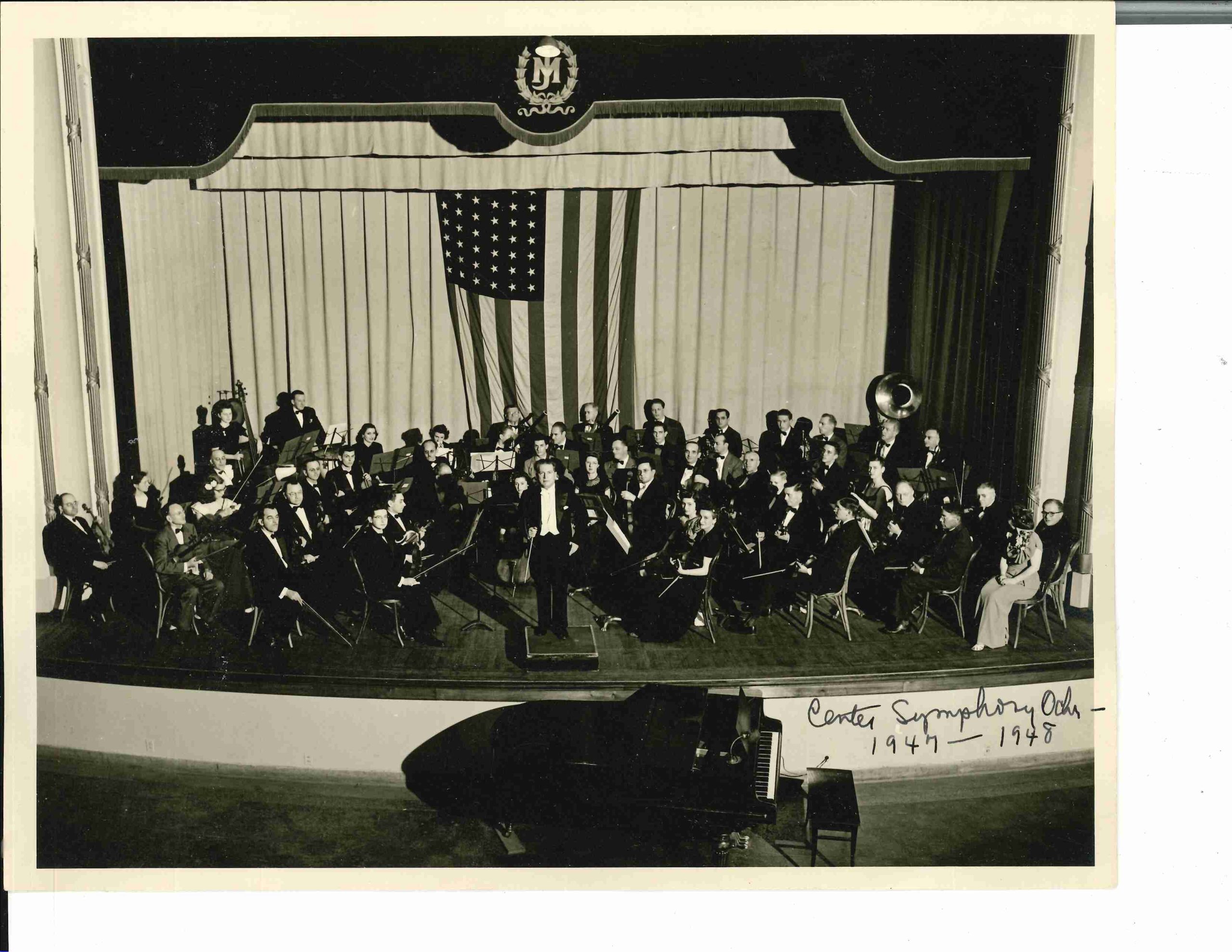
Community Legacy
Peter Lisowsky conducted the community orchestra until his death in 1970. Having served in World War I, he was buried in the cemetery at Fort Snelling, his grave adorned simply with a Star of David. His wife Agnes, who was twelve years his junior, would not pass away until 2004.55 They did not have children. Years after his death, a 1986 Star Tribune article on the orchestra noted the long shadow he still cast, noting that “the long-term members get together to talk of conductors of the past, especially of the moody Peter Lisowsky (‘We all loved him; we all complained about him.’)”56
The St. Paul JCC Symphony Orchestra still thrives to this day, nearing what they will be touting as their one hundredth anniversary. Their publicity still highlights their inclusivity and diversity of musicians from all backgrounds.57 It remains evident that early histories of organizations are tricky. When the orchestra celebrated their ninetieth anniversary in the 2017/18 season, they chose to count from the 1928 founding date that folds in Lisowsky’s early group, prior to the founding of the Center itself in 1930. (They also claim the group as the longest-running community orchestra in the country.)58 But even that choice of including Lisowsky’s 1928 founding hasn’t always been consistent. Center reports in 1943 note the orchestra’s tenth anniversary; 1958 correspondence notes their twenty-fifth anniversary. Clearly, in these early years, the founding of the group was indeed traced back to Lisowsky’s first season at the Center in 1932/33; only years later does the story shift to draw in those early Lisowsky orchestra years at other locations prior to being at the Center—some say 1925, others 1928. All of these differing years, however, have one thing in common: centering Peter Lisowsky’s influence on the orchestra.
Where is the beginning? And is the group, now known as the Minnesota JCC Symphony Orchestra, the oldest community orchestra still in existence in the United States? Was the pull of the great and powerful Lisowsky the reason for the success of the group, setting up yet another mythos around a musical man? Origins remain tricky, but what endures is a fascinating legacy of a long-running American community orchestra, based right here in St. Paul.
Kate Dietrick has been the Archivist for the Upper Midwest Jewish Archives at the University of Minnesota Libraries since 2013. She holds a Masters of Information and Library Science from Pratt Institute in Brooklyn, New York, with certificates in both Archives and Museum Libraries, and a Bachelor of Arts in History and Women’s Studies from St. Olaf College in Northfield, Minnesota. She is an active member of the Twin Cities Jewish community and a proud St. Paulite.
Notes
- Publicity, n.d., box 22, folder 19, St. Paul Jewish Community Center records, Upper Midwest Jewish Archives, University of Minnesota (hereafter SPJCC records).
- “Minnesota JCC Symphony Orchestra,” Minnesota JCC, December 29, 2025, https://minnesotajcc.org/art-culture/music/.
- Publicity, SPJCC records.
- Laura Weber, “Jewish Community Center of St. Paul,” MNopedia, published May 14, 2014, last modified April 10, 2025, https://www.mnhs.org/mnopedia/search/index/group/jewish-community-center-st-paul/.
- For more, see boxes 1, 2, 3, and 22, SPJCC records.
- Weber, “Jewish Community Center of St. Paul.”
- Dedication of the Jewish Educational Center, 1930, box 1, folder 2, SPJCC records.
- Report of the Executive Secretary, December 16, 1930, box 1, folder 5, SPJCC records.
- Jewish Educational Center to Jesse B. Calmenson, February 2, 1931, box 3, folder 10, SPJCC records.
- Jewish Education Center Orchestra: Rehearsal at Center, n.d., box 3, folder 10, SPJCC records.
- Untitled report, n.d., box 1, folder 5, SPJCC records.
- Secretary’s Report to the Board of Directors, January 12, 1932, box 1, folder 5, SPJCC records.
- “Orchestra Seeks Active Members,” The Center News, April 1, 1932, box 3, folder 14, SPJCC records.
- Brief Outline of Cultural Activities, n.d., box 1, folder 5, SPJCC records.
- Executive Secretary’s Report, December 15, 1932, box 1, folder 5, SPJCC records.
- Annual Report Cultural Division, 1933, box 1, folder 5, SPJCC records.
- “Peter Lisowsky,” Find a Grave, March 3, 2000, https://www.findagrave.com/memorial/3469089/peter-lisowsky.
- Natalie Gerstein, “St. Paul’s Lisowsky,” Twin Citian, May 1966, 72-73, box 22, folder 28, SPJCC records.
- See various newspaper clippings from scrapbooks, box 7, folder 1, and box 13, folder 4, Peter and Agnes Lisowsky papers, Performing Arts Archives, University of Minnesota (hereafter Lisowsky papers).
- Gerstein, “St. Paul’s Lisowsky,” 72
- Gerstein, “St. Paul’s Lisowsky,” 72.
- United States of America Passport Application, August 28, 1922, accessed July 21, 2025, ancestry.com.
- Peter Lisowsky to Agnes Thro, January 24, 1929, box 3, folder 1, Lisowsky papers.
- Peter Lisowsky to Oscar Haugland, June 12, 1929, box 1, folder 2, Lisowsky papers.
- Peg Meier, “Born to Make Music,” Star Tribune, November 17, 2002, box 7, folder 5, Lisowsky papers.
- Center Symphony Orchestra, box 22, folder 4, SPJCC records.
- Gerstein, “St. Paul’s Lisowsky,” 72.
- Executive Secretary’s Report, December 15, 1932, box 1, folder 5, SPJCC records.
- “Lisowsky Will Lead Orchestra At Center Again,” The Center News, October 19, 1934, box 3, folder 14, SPJCC records.
- “To the members of the Committee evaluating the Program of the Jewish Center Activities Association,” March 22, 1935, box 1, folder 5, SPJCC records.
- Letter to unnamed committee members, May 18, 1936, box 1, folder 5, SPJCC records.
- Gerstein, “St. Paul’s Lisowsky,” 72.
- Peter Lisowsky to “My dear colleague of the Center Symphony Orchestra,” n.d., box 22, folder 18, SPJCC records.
- Gerstein, “St. Paul’s Lisowsky,” 72.
- Program for Center Symphony Orchestra, May 5, 1936, box 22, folder 26, SPJCC records.
- “Conductor,” Pioneer Press, September 17, 1944, box 22, folder 5, SPJCC records.
- “Jewish Center Symphony Orchestra,” The St. Paul Musician, n.d., 11, box 22, folder 8, SPJCC records.
- “Conducts Two Orchestras…Peter Lisowsky’s Musical Inheritance Benefits Entire St. Paul Community,” St. Paul Jewish News, n.d., 3, box 22, folder 4, SPJCC records.
- For more, see Eric Goldstein, The Price of Whiteness: Jews, Race, and American Identity (Princeton University Press, 2006).
- Paul Berman, Blacks and Jews: Alliances and Arguments (Delacorte Press, 1994), 14.
- “It’s your Center!,” 1943, box 22, folder 25, SPJCC records.
- “Digest of Self-Study of Informal Recreational and Educational Activities of the Jewish Community of St. Paul,” November 1948, box 2, folder 25, SPJCC records.
- “An Important Musical Event,” n.d., box 22, folder 8, SPJCC records.
- Center Symphony, 1962, box 22, folder 19, SPJCC records.
- “Symphony of the World,” Ebony, November 1966, 39.
- “Soloists Lead Jewish Concert,” 1965, box 22, folder 8, SPJCC records.
- “Symphony Fosters Racial Harmony,” St. Paul Dispatch, May 14, 1963, box 22, folder 8, SPJCC records.
- “Music Goes Round and Round—Ph. D.’s and Businessmen Beat It Out with Bach,” St. Paul Dispatch, May 18, 1956, 1, box 22, folder 3, SPJCC records.
- “The Oliver Towne Column: An Orchestra Is More,” 1962, box 22, folder 4, SPJCC records.
- Attendance and member records, box 2, folder 23, box 22, folder 19, and box 22, folder 20, SPJCC records.
- Louis Goldstein to Samuel Rosenbaum, April 29, 1957, box 22, folder 19, SPJCC records.
- “Top Songs of 1957,” Top 40 Weekly, accessed July 21, 2025, https://top40weekly.com/1957-all-charts/#US_Top_40_Singles_For_The_Week_Ending_17th_April_1957Issue_Date_27th_April_1957.
- “Adventures in Music: Young People’s Lollipop Concert,” 1973, box 22, folder 3, SPJCC records.
- Weber, “Jewish Community Center of St. Paul.”
- “Peter Lisowsky,” Find A Grave.
- Peg Meier, “Playing with orchestra has set rhythm of some members’ lives,” Minneapolis Star and Tribune, February 2, 1986, 8F.
- “Music,” Minnesota JCC, December 19, 2025, https://minnesotajcc.org/art-culture/music.
- “St. Paul JCC Orchestra 90th Anniversary Video,” YouTube, July 31, 2017, https://www.youtube.com/watch?v=5Sa5JDUeyW4.
- Year
- 2026
- Volume
- 61
- Issue
- 1
- Creators
- Kate Dietrick
- Topics