
Many Backgrounds, One Goal – Persistence Exhibit
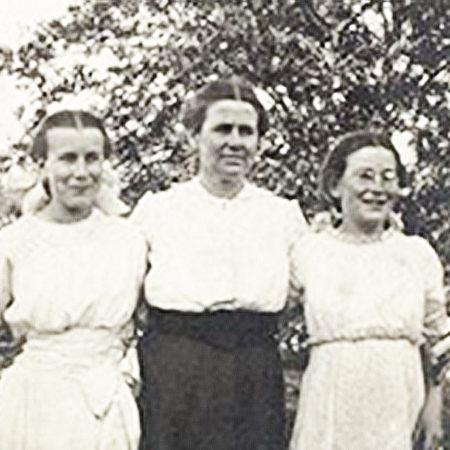
Suffragists came from many different backgrounds. Many were working class women with jobs in factories and stores. Some were from ethnic and racial minority groups. Some lived in small towns or on farms. Some were career women—doctors, lawyers, teachers, reporters. Others were middle or upper middle-class women who did not work outside the home but who had useful connections, as well as the time and resources to devote to the cause.
While most of the suffrage work in Minnesota focused on the Twin Cities, there were small suffrage clubs throughout the state, from Duluth and Rochester to Pipestone and Pine Island. Still, the MWSA had limited resources, and it was hard for them to reach all corners of Minnesota. In the final push for ratification of the Nineteenth Amendment, organizers visited communities where the people had never learned about women suffrage.
By 1913, the fight for woman suffrage had been going on for decades. Women had full voting rights in some states in the West. But in others like Minnesota, they could only vote in school and library board elections.
Stefanie Kiihn
Ink
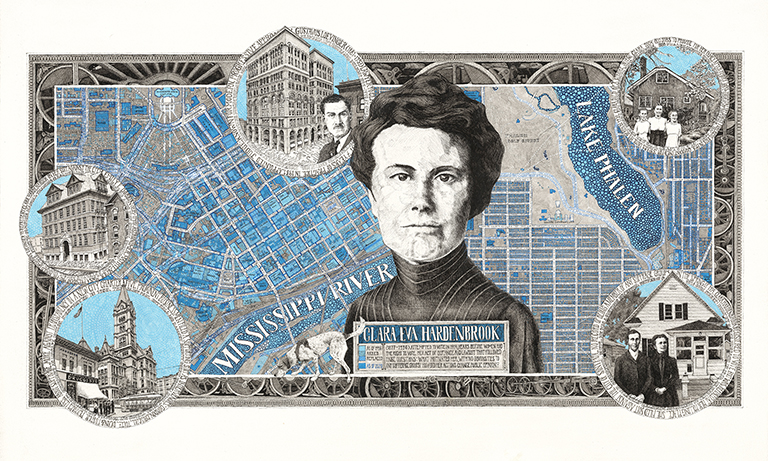
Clara Eva Hardenbrook
Clara Hardenbrook (1877-1936) was a working-class woman who lived with her family on the East Side of St. Paul. Since 1875, women in Minnesota had been eligible to vote in school board elections, and a new city charter was going to affect the way St. Paul schools were governed. Hardenbrook registered to vote as C. E. Hardenbrook, but when she tried to vote on May 7, 1914, she was turned away from the polls. The case went all the way to the Minnesota Supreme Court, which issued a decision against the activist in December 1914. After her court case, Hardenbrook returned to her working-class life.
Hardenbrook registered to vote as C. E. Hardenbrook, but when she tried to vote on May 7, 1914, she was turned away.
About the Artist – Stefanie Kiihn
Clara Eva Hardenbrook attempted to vote in 1914, years before women were granted the right to vote. She contributed to changing public opinion and left a legacy of valuing the right to vote and taking a stand.
To the left of her portrait, a map of downtown St. Paul commemorates the lawsuit that followed Clara’s act of defiance. Medallions feature:
- Clara’s lawyer Gustavus Loevinger at the Germania Life Insurance building where he officed
- Lawsuit organizer and suffragist Emily Dobbin at the Mechanic Arts High School where she taught math
- The old Ramsey County Courthouse with the businessmen who filed an intervening suit
To the right of her portrait, a map of St. Paul’s east side shows where Clara lived and describes her personal story. Medallions feature:
- Clara and her first husband, Harry Hardenbrook, in front of their home at 1016 Cook Street
- Clara and her daughters in front of 886 Phalen Ave, where she lived after Harry’s death
Artist Bio
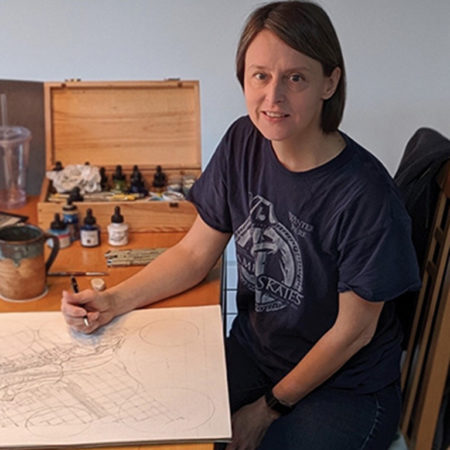
Stefanie Kiihn is a Minnesota-based artist who works in pen and ink. The principal theme in Stefanie’s art is the history of a place. Her favorite location is Saint Paul. Her work investigates neighborhoods to match historic maps to current streets and buildings. She researches the people and architecture of the past to locate the ghost-like footprints that are left. What did the city look like before freeways and railroads? Where are the lost neighborhoods and lost ways of life? What architectural treasures have been lost? What forces preserved the historic buildings that still survive? Who shaped the city we know today?
Stefanie grew up in Saint Paul, Minnesota. She has a Bachelor of Fine Arts degree from the University of Minnesota. She exhibits locally and regionally, including the Minnesota State Fair Fine Arts Competition, White Bear Center for the Arts, and Natural Heritage Project. She currently lives in Roseville with her husband and hound-mix named Darla.