
Supreme Court – Persistence Exhibit
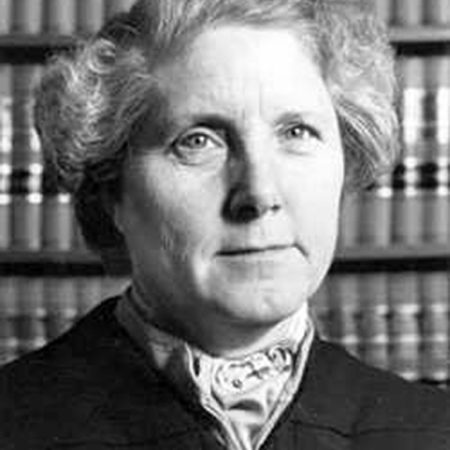
In the 1970s, DFL women began to organize and work for more women to be appointed in government. They set their sights on getting a woman appointed to the Minnesota Supreme Court. This would allow them to last beyond the current governor.
Rosalie Wahl (1924-2013) was the first woman on the State Supreme Court. Born in Kansas, she entered the University of Kansas in 1942. While there, she helped establish an interracial housing co-op. After graduating in 1946, she married and moved to Minnesota in 1949. In 1962, she enrolled in William Mitchell College of Law at the age of thirty-eight, in part because she said that she “was tired of sitting outside doors and waiting for men to make the decisions.” Upon graduating and passing the bar, she worked as an assistant public defender. In 1972, she taught criminal law at William Mitchell and at the University of Minnesota School of Law.
Wahl was appointed to the Minnesota State Supreme Court by Governor Rudy Perpich in 1977. Perpich later said one of the reasons he appointed Wahl was that he was convinced she would be able to win the political campaign to keep her seat. Wahl served as liaison to the court’s Study Commission on the Mentally Disabled. She also chaired its task forces on gender fairness and racial bias. Each of these assignments brought significant change to the judicial system in Minnesota. She was known for leading efforts to address both gender fairness and racial bias in the judicial system until 1992 when she retired.
In 2020, four of the seven justices on the Minnesota Supreme Court were women, Lorie S. Gildea (Chief Justice), Anne K. McKeig (Justice), Natalie E. Hudson (Justice), and Margaret H. Chutich (Justice).
Minnesota has had nine women serve as lieutenant governor, starting with Marlene Johnson in 1983, but a woman has never been elected governor. In 2018, Minnesota elected Peggy Flanagan, its current lieutenant governor and the first Ojibwe person to be elected to State-wide office in Minnesota.
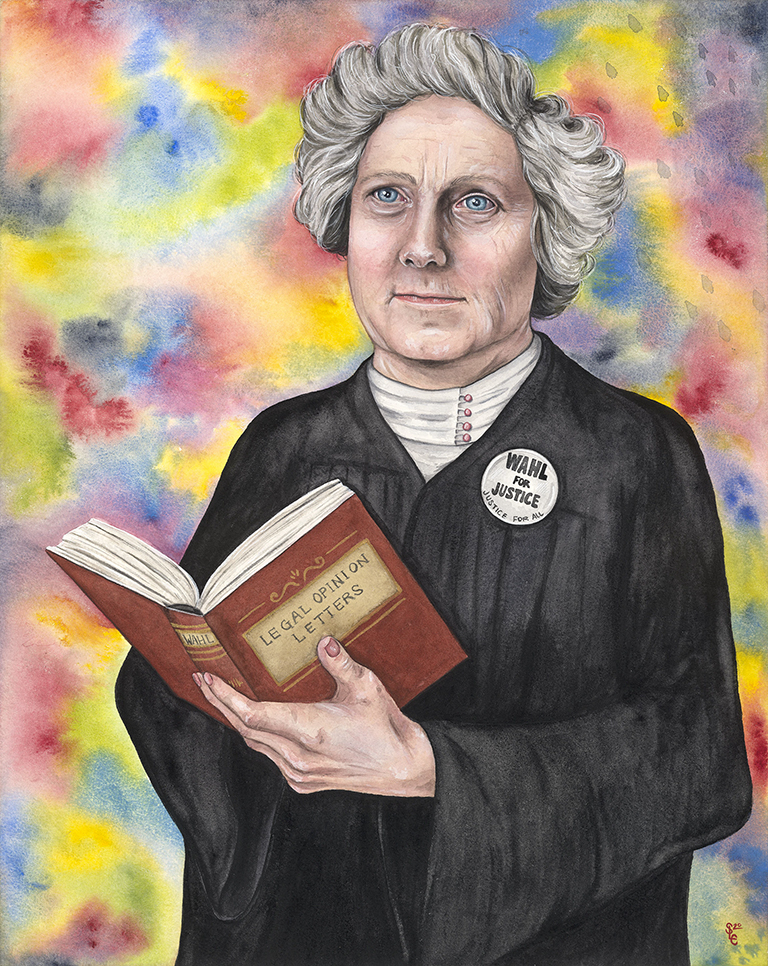
Stacey Combs
Watercolor, 2020

About the Artist – Stacey Combs
“I’m tired of sitting outside doors waiting for men to make the decisions.”- Rosalie Wahl
Stacey Combs (AKA stace of spades) leapt at the opportunity to participate in Persistence. While she uses varied styles and subjects, Stacey is a portrait artist first and foremost. Often working with themes of social justice and inclusive feminism in her artwork, she draws attention to unfair and outdated social norms. Painting Rosalie Wahl for Persistence was a no-brainer for Stacey, as Ms. Wahl worked hard to address these same issues. Gender fairness, racial bias, and justice for all were cornerstones of her career, and are represented by the colorful background. The artist chose bold colors, intermingling to represent the fight for racial and gender equality.
Rosalie Wahl truly was a remarkable woman. Strong and compassionate, she cleared a path for many to follow.
Rosalie Wahl may be best known for being the first woman in state history named to the Minnesota Supreme Court. She was a trailblazer in the legal field, and authored 549 opinions for the court during her 17 years of service. She is shown holding a book containing these letters in this painting. She is known nationally for her work on the American Bar Association, headed up task forces that made major changes in the way Minnesota’s court system dealt with women and minorities, and served as liaison to the court’s Study Commission on the Mentally Disabled.
Artist Bio
Stacey Combs (AKA stace of spades) is a fine artist and illustrator based out of south Minneapolis. She has been an artist in one form or another for nearly her entire life. She is self-taught, but has had a little help here and there.
Much of the work that she does is portraiture, with her primary mediums being watercolor, gouache, and ink. She paints landscapes and beer bottles as a fun way to document her travels. She also creates custom sentimental artwork for people, with some illustration work sprinkled in. On the more serious side, she often works with themes of environmentalism, social justice, and feminism. She uses this work to draw attention to unfairness and outdated social norms.
You can find Stacey all around the Twin Cities. She frequently participates in art fairs and hangs her work in various spaces from galleries to donut shops, and even billboards.