
Pierce Butler’s Seventeen Years Serving as St. Paul’s First US Supreme Court Justice
- Year
- 2026
- Volume
- 61
- Issue
- 2
- Creators
- Paul Nelson and James Fleming
- Topics
“Horseman of the Court”
by James Fleming and Paul Nelson
The following is the second of a two-part series about the life and career of Pierce Butler. To read the first article on Butler’s early career in St. Paul, see Vol. 61, No. 1 of Ramsey County History.
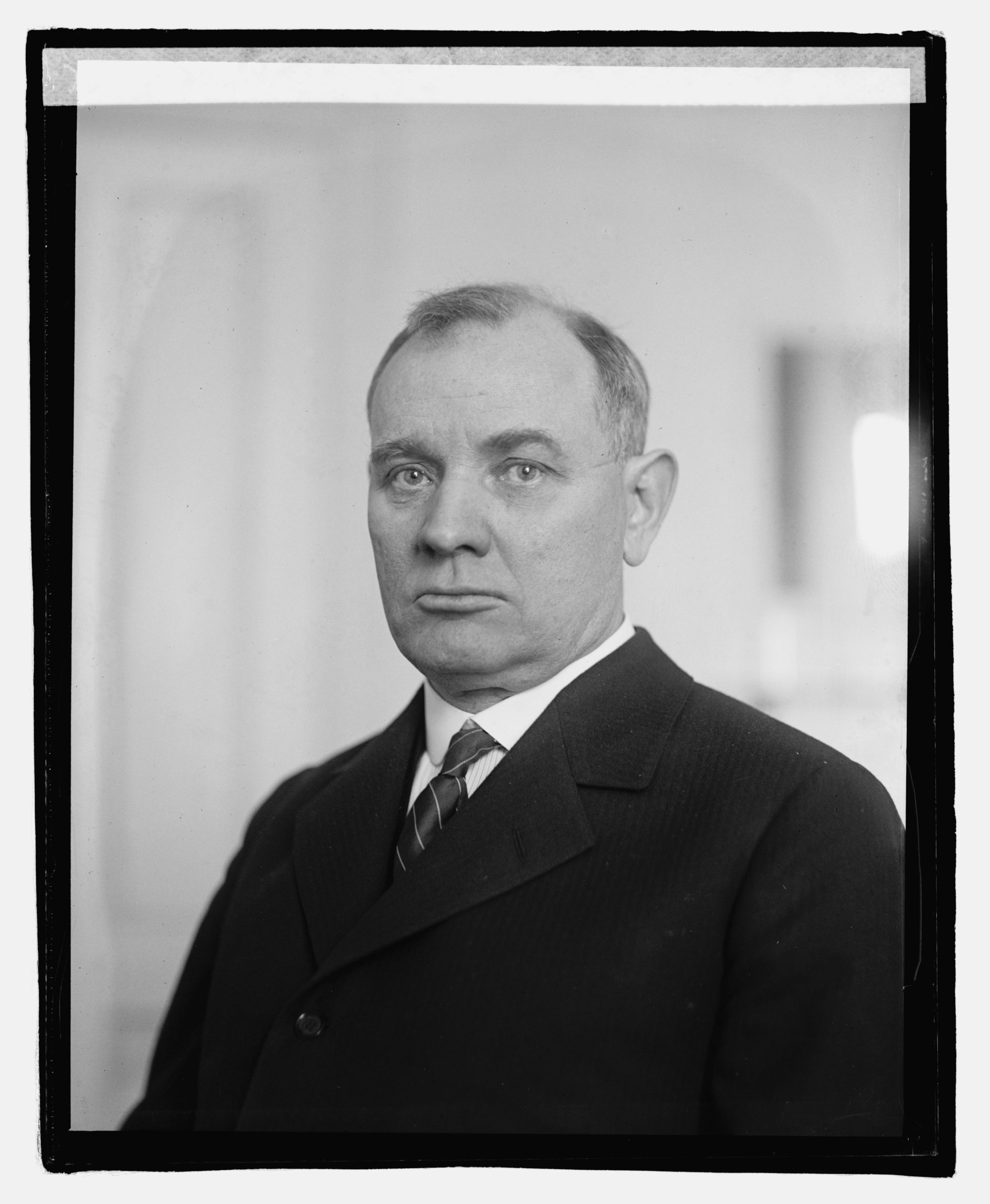
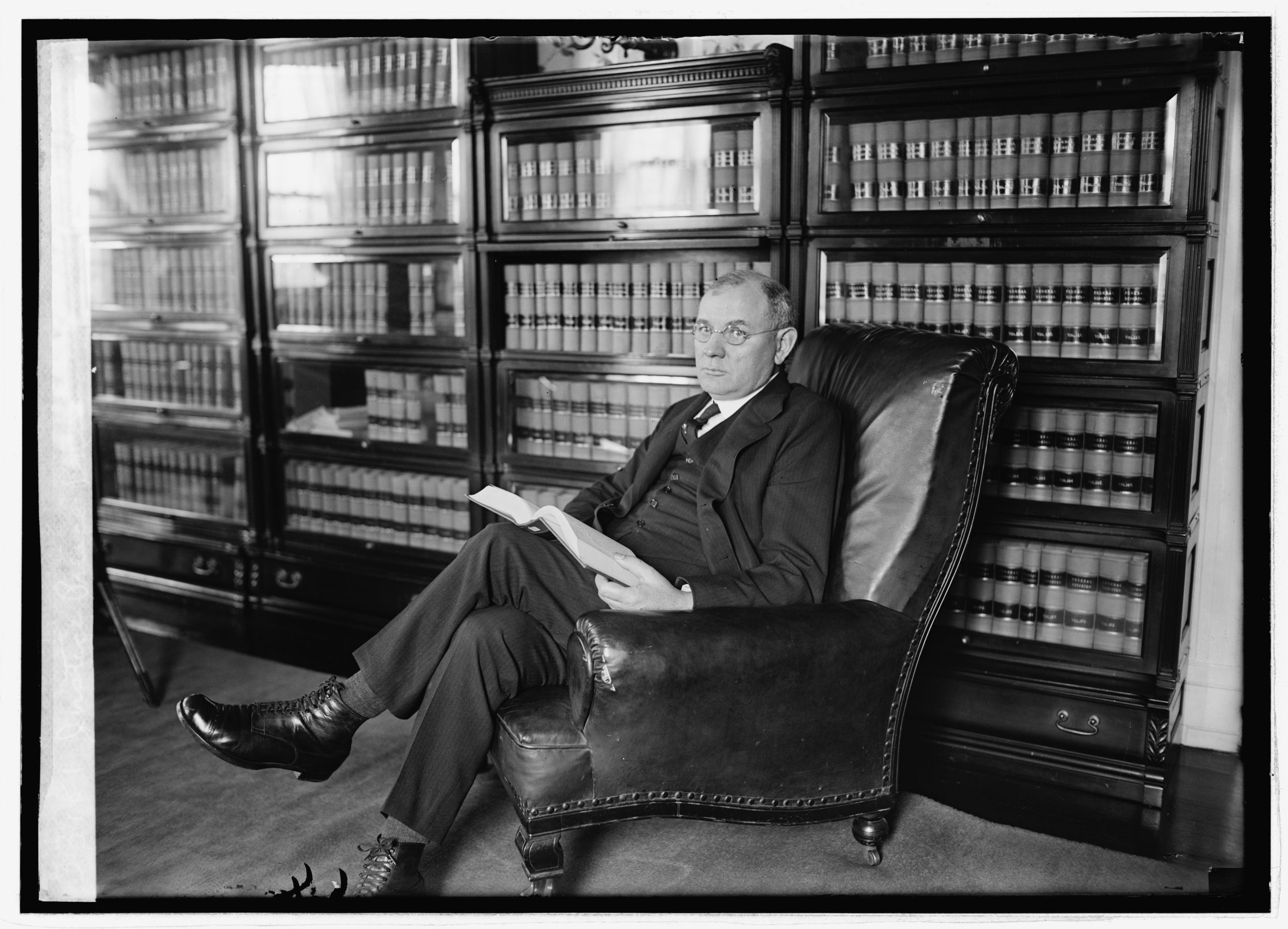
Why should Ramsey County remember Pierce Butler? For one good reason: He was the first Minnesotan (and St. Paulite) to serve on the United States Supreme Court.
But the judgment of history has been harsh. The rather few scholars who have paid attention to Butler’s judicial career have rated him undistinguished at best.1 Such ratings are subjective, but the core of them are an assessment of whether a judge’s opinions have had a lasting impact on the law; Butler’s have not.2 On the court, he was never a star, nor did he strive to be one. On those rare occasions when he had a chance to shine (see: the Buck v. Bell online sidebar), he declined. He wrote the majority opinion for only one historically pivotal case, a case that marked the end of one Supreme Court era, and which also touched off the most consequential defeat of Franklin Roosevelt’s presidency. We’ll come to that story later, but remember the name: Tipaldo.
When Butler joined the Supreme Court in January 1923, he was just what President Warren Harding and Chief Justice William Taft were looking for: a Catholic, a Democrat, a hard worker, and a reliable conservative whose legal thinking was firmly grounded in the nineteenth century.3 (Taft told Harding that Butler was a Democrat, “but not enough of a Democrat to hurt.”)4 The nation was still reacting to the perturbations wrought by the Great War, including vastly increased federal power; the railroads, for example, had been temporarily nationalized. There had been too much change.
Harding had been elected on the slogans “Triumphant Nationality” and “Back to Normalcy.” The key word there was “back”: back to pre-war America, back to a federal government that did as little as possible. He chose former President Taft as Chief Justice in 1921, precisely to move the Supreme Court back toward nineteenth-century concepts, particularly in the areas of government meddling in the economy (bad).
Congress followed similar impulses. In 1921 it passed the eugenics-inspired Emergency Quotas Act, followed in 1924 by the even more drastic Asian Exclusion Act and National Origins Act. From the 1890s forward, the United States had seen an unprecedented surge of immigration from eastern and southern Europe—Jews, Slavs, Sicilians—that made many Americans, including in the elite classes, uncomfortable. They saw the new immigrants as inferior and feared that they would degrade the country’s heretofore genetic “excellence.” The new law set quotas designed to permit immigration mostly from the country’s early sources in northern Europe. Back, back, back. (The country’s current immigration turmoil has a precedent almost exactly one century old.)5
Pierce Butler was the perfect man for this moment. He detested government economic regulation and social programs of all kinds. American citizenship, to him, carried with it the duty of unquestioning obedience to government (as we saw with the Warren Schaper case in part one of this series, where the University of Minnesota professor lost his job over Butler’s perception of his insufficient patriotism). To Butler, pacifism and socialism were alien and abhorrent concepts. In 1926 Time magazine observed that Pierce Butler was “ruthless, intolerant, forceful, impatient with all forms of progressive thought.”6 This made him, to Taft, a man of “sound . . . constitutional views.”7
The qualities he had developed in St. Paul—industry, determination, preparation, inflexibility, and a supreme conviction of his own rightness—served him well on the court for almost a decade. According to the leading historian of the Taft Court, Robert Post, while Taft remained chief justice (he resigned in 1930), Butler was one of the toughest judges “in conference”—that is, in the meetings among the justices where they hashed things out—and also one of the most persuasive. No one was better than him at turning divided decisions into unanimous ones, a quality prized by Chief Justice Taft.8
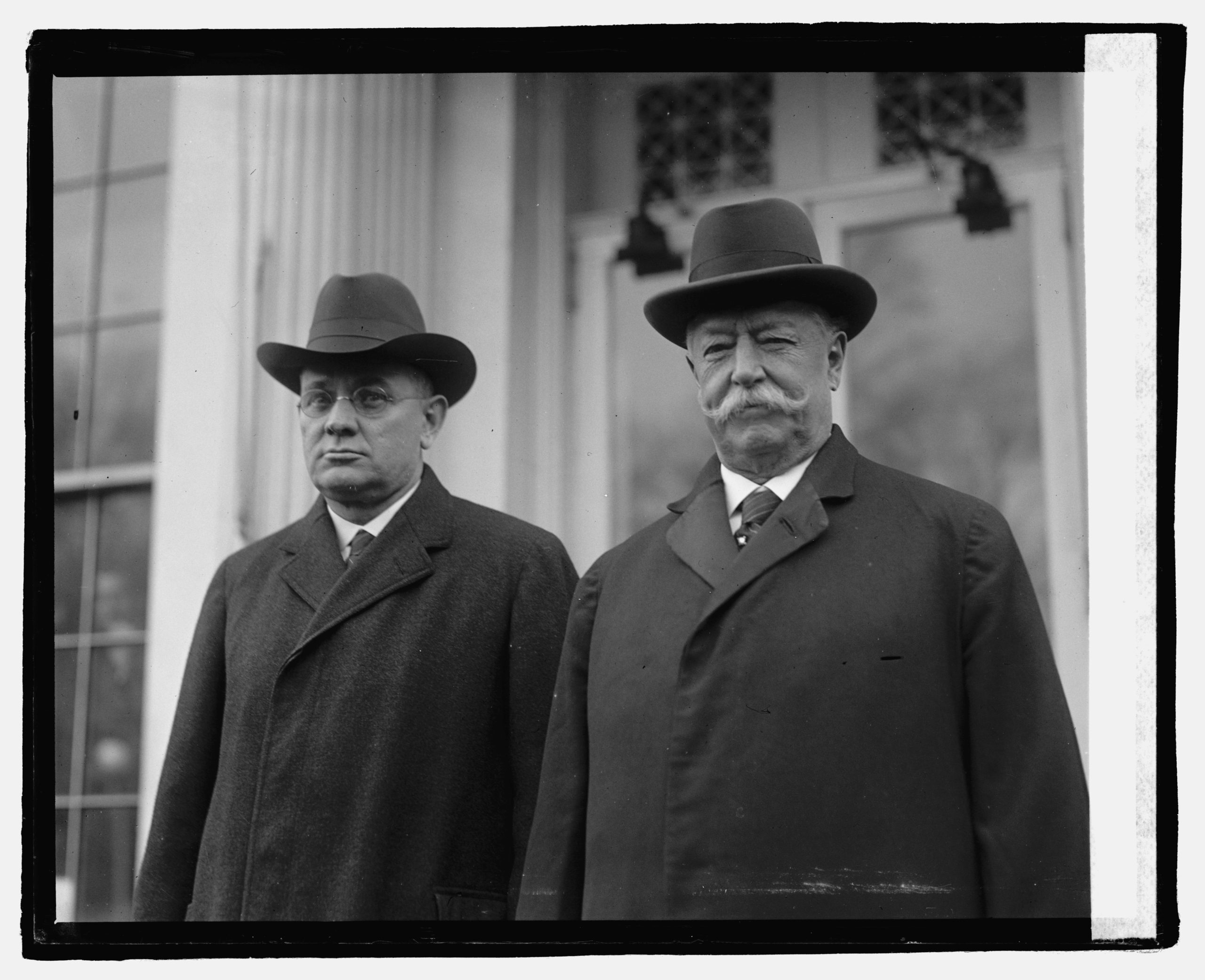
Because the Supreme Court makes the news only in cases of controversy, like gun control, some readers may suppose that big stuff is all it does. But the contrary is true. Most of the cases it takes, though difficult, matter deeply to the litigants but do not affect the general public. The issues are technical and arcane, and the Court’s opinions, where the justices explain what they decide, are incomprehensible for most people.
In his nearly seventeen years on the Supreme Court, Pierce Butler wrote over three hundred majority (that is, winning-side) opinions, nearly all of them unanimous.9 Most dealt with knotty stuff like railroad and utilities regulation, Butler’s area of expertise. There were few deeply divisive cases, and this was probably a congenial time for Butler. Taft had, with President Harding’s acquiescence, built a reliable core of conservative justices: Taft, Willis Van Devanter, George Sutherland, James McReynolds, and Butler—like-minded men of similar ages. The latter four became a bloc, meeting, socializing, golfing, and voting together. In time they would become known, disparagingly, as the Four Horsemen (as in, of the apocalypse).10 More about that later.
Butler took office in a time of comparative national prosperity and consensus. Both were shattered by the coming of the Great Depression in 1929. That, in turn, brought the 1932 election of Franklin Roosevelt as president, and with him an endless number of laws, programs, and agencies designed to restore some measure of prosperity, or at least hope. Butler, deeply suspicious of such meddling, considered FDR “a damned fool.”11
Roosevelt was determined to use every legitimate power of the state to fight the national crisis. The Horsemen were equally determined to resist him, and with four of the nine Supreme Court votes, they were in a strong position to do so. FDR and Congress rushed many programs into life in 1933 and 1934; then the legal challenges to them worked their way through the courts. Everyone knew a crisis might come.
And then it came. Between January of 1935 and May of 1936, the Supreme Court ruled six Depression-fighting programs unconstitutional: the Railroad Retirement Act, the Agricultural Adjustment Act, the Guffey Coal Act, and the National Recovery Act (Roosevelt’s keystone).
All these were federal statutes designed to help some large and suffering category of people, including rail workers, farmers, and miners. Pierce Butler voted to strike down all of them.12
We come now to Tipaldo. The last big case of this set, which set off the Judicial Crisis of 1937 (as historians have called it), was a New York state minimum wage case called Morehead v. New York ex rel. Tipaldo. This was a close, 5–4 decision—the Four Horsemen plus one—with the opinion by Pierce Butler. This was the only truly important opinion he ever wrote. The Supreme Court, the New Deal, and American constitutional law would never be the same again.
The Tipaldo Case
Joe Tipaldo was the manager of the Spotlight Laundry in Brooklyn, and a bad boss. In 1933 the New York legislature had passed a minimum wage/maximum hours law for female laundry workers; the Depression had driven pay so low that, in the legislature’s view, many women were working at starvation wages. Tipaldo responded by pretending to pay his female workers the minimum, then requiring kickbacks. He was caught, convicted, and sent to jail. Laundry and hotel businesses, hostile to minimum wages, pooled money to make Tipaldo’s case a test of New York law.
Tipaldo and his enablers had good reason to be optimistic. Just ten years earlier, in 1923, the US Supreme Court had ruled a very similar law, setting minimum wages for women and children in the District of Columbia, unconstitutional: Adkins v. Children’s Hospital. Though this was long before the Depression, the impulse was the same, to protect from exploitation workers who had no effective bargaining power.13 It was the kind of law that Pierce Butler and the Four Horsemen disdained.
Adkins was a 5–3 decision, with one justice, Louis Brandeis, not taking part, and three dissenting. When Tipaldo came along, in 1936, two enormous changes had taken place. One was the Depression, which put powerful pressure on government to act for suffering workers. The other was Supreme Court turnover: all the justices who dissented in Adkins were gone, along with one who voted with the Horsemen. This set up the possibility of a 5–4 split, with a single justice who had not voted in Adkins deciding the fate of Tipaldo—and, by extension, the future of the New Deal.
Owen Roberts was that single justice, a Republican appointed by President Hoover in 1930. Roberts had been hard to pin down in New Deal cases; sometimes he voted with the Horsemen, sometimes not. This time he did, giving them a 5–4 majority. Pierce Butler, who almost never got a writing assignment in a close case, got this one. It would change his life.
He probably found writing it rather easy. The controlling precedent was Adkins, and so Butler’s opinion in Tipaldo relied heavily on Adkins and reached the same result. It has been written that Pierce Butler pared his judicial prose to remove any language that might prove to be memorable,14 but in this case, Butler changed his tone. Confrontational and defiant, Butler wrote: “The State is without power by any form of legislation to prohibit, change or nullify contracts between employers and adult women workers as to the amount of wages to be paid.”15
Butler’s Tipaldo opinion reflected his hardened nineteenth-century views. While countless workers across the country were being crushed by starvation wages, “the state is without power by any form of legislation” (emphasis added) to intervene. Here was Pierce Butler’s worldview, forged on the Dakota County frontier, grilled into him at Carleton, and petrified in certainty through his decades of success (and wealth), made the immutable law of the nation. The French novelist and poet Anatole France had written that “the majestic equality of the laws . . . forbid rich and poor alike to sleep under the bridges, to beg in the streets, and to steal their bread.”16 Pierce Butler now suggested an American counterpart: The Constitution, in its magnificent equality, permits rich and poor alike to toil their lives away in sweatshops.17 Butler had put a dagger into any legislative action to ameliorate the calamity of the Great Depression for workers.
Historian William Leuchtenberg called Tipaldo “the most consequential event of all.”18 It seemed to confirm what Attorney General Homer Cummings had warned FDR: “Mr. President, they mean to destroy us . . . We will have to find a way to get rid of the present membership of the Supreme Court.”19
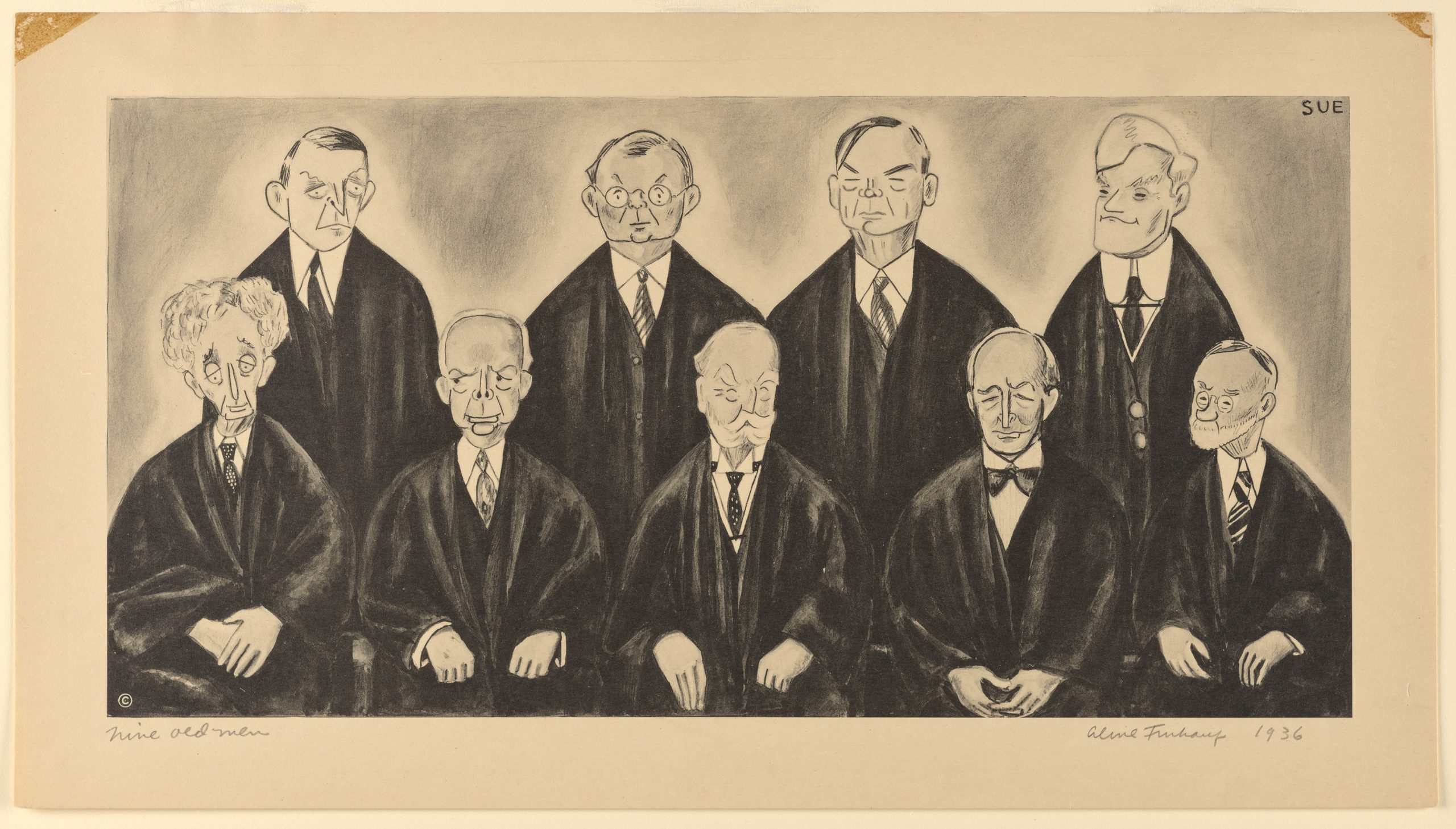
Tipaldo came down on June 1, 1936, just as the campaigns for the fall presidential and congressional elections were beginning to move. Roosevelt was popular but the Depression had not relented; no one knew what to expect in November. The popular response to Tipaldo, nationwide, was overwhelmingly negative. The Republican Party, fearing its backlash, took the extraordinary step of condemning the decision, which was so out of sync with the times.20
Roosevelt, who had been uncertain how, when, and even if to act against the Supreme Court, now decided to take Cummings’s advice. He would act, but wait for the right moment. The election brought it nearer. His unprecedented victory—over sixty percent of the popular vote and complete control of Congress—showed that the people had voted overwhelmingly for Roosevelt and against the Supreme Court.
On February 5, 1937, Roosevelt struck. In an address to the nation, he announced his so-called court-packing plan, a reform of the federal court system that would permit the president to appoint an additional judge, at all levels, including the Supreme Court, for every judge over seventy who declined to retire. All four of the Horsemen (and two other justices) were older than seventy. This would not require a Constitutional amendment because the Constitution did not fix the number of Supreme Court justices; that was up to Congress. If approved, the plan would give Roosevelt six appointments to the Supreme Court and boost its size to fifteen.
Despite Roosevelt’s popularity and congressional majorities, opposition to his proposal grew and spread, including in his own party. People saw it for what it was, a presidential takeover: They hated this particular court’s intransigence but respected the court as an institution. And no president, no matter how critical of the Supreme Court, had ever dared act against the institution itself. A letter published February 10 in the Minneapolis Journal provides an example of the reaction: “Having made a rubber stamp out of Congress and a bunch of office boys out of the cabinet, he [FDR] now proposes to dictate to the Supreme Court. Truly, one is tempted to say with Cassius . . . ‘Upon what meat doth this our Caesar feed, that he is grown so great?’ ”21
The struggle rumbled on all through the spring and summer of 1937, with opposition gaining strength week by week. On July 14, 1937, Senate Majority Leader Joe Robinson went home from a long, hot session of trying to force the bill through, collapsed, and died. The Judicial Procedures Reform Bill of 1937 died with him. (The bill did ultimately pass, but stripped of the key language.) Historian William Leuchtenberg wrote, “Roosevelt had suffered a severe setback, and his proposal had drawn its last breath.”22 And Pierce Butler’s opinion in Tipaldo had touched it off.23
This was a stunning victory for Butler and the Horsemen. But now a series of events in quick succession turned that apparent victory into a defeat so thorough that it has been called a constitutional revolution.
While the reaction to Tipaldo was being absorbed, the 1936 elections fought, and the court-packing wrangle resolved, still another minimum-wages-for-women case made its way to the Supreme Court. Washington State had a similar law for decades, but it went unenforced. Elsie Parrish worked as a hotel housekeeper in Wenatchee for eighteen months, and over that time was paid $216 less than the statutory minimum. When she quit, she demanded that amount, her employer refused, and she sued. Because of Tipaldo, she lost at every level. But she kept appealing.
With rare exception, the Supreme Court takes only the cases it wants to hear. That it heard arguments in the Parrish case in December 1936, less than six months after the Tipaldo decision, signaled that something had changed. That change, never fully explained, took place in the mind of Owen Roberts.
Like Tipaldo, the Parrish vote was 5–4; the only difference was Justice Roberts, who switched sides. A shockingly short time had passed: Tipaldo was decided June 1, 1936; Parrish came down on March 29, 1937. It was, in effect, an admission that Tipaldo, and Adkins before it, were simply wrong. Chief Justice Hughes, writing for the majority, got right to the issue that had been skated over, and by implication denied, in Tipaldo: a state’s compelling interest in forbidding sweatshops. He wrote, “What can be closer to the public interest than the health of women and their protection from unscrupulous and overreaching employers? And . . . how can it be said that the requirement of the payment of a minimum wage fairly fixed in order to meet the very necessities of existence is not an admissible means to that end? . . . The legislature was entitled to adopt measures to reduce the evils of the ‘sweating system.’ ”24
Butler joined in Justice Sutherland’s understandably angry dissent, but according to historian Leuchtenberg, the Horsemen understood immediately that they and their way of thinking, in command for so long, had been, just nine months after Tipaldo, made obsolete.25 Thus was “liberty of contract” in employment, free from government regulation, so cherished by Pierce Butler and the Horsemen, swept away. And here was the constitutional revolution: The government was now free to regulate wages to ameliorate the effects of the Depression. The nineteenth century was over.
A Tragic Turn
Butler’s last three years on the court cannot have been happy ones. In 1937 his friend Van Devanter left, followed in 1938 by Sutherland.26 He and his remaining mate, McReynolds, fell into increasing isolation. In his first three years as a justice, Butler had dissented twice. In his last three, after Tipaldo, forty times. Tipaldo was a victory that returned only gall. Pierce Butler had not changed; the personnel of the court had changed, and that meant, in effect, that the Constitution had changed. He must have hated the transformation, but if he felt anger, no anger showed in his opinions; they remained measured and well-composed.27
In early 1938, a mysterious tragedy struck him and his family. His son Kevin, the youngest child born in 1905, died on a journey from St. Paul to New York. He was on a passenger train near Greensburg, southwest Pennsylvania, when he fell into a ravine and fractured his skull. The version of events published in most newspapers, probably the official family version, was that a sudden movement of the train on a curve thrust Kevin through a bathroom window,28 and this is repeated in the death certificate.29 But it is not believable. The force required to propel a full-grown man through the small window of a railcar bathroom would be stupendous, and trains must reduce speed on curves. The Minneapolis Star, alone among local papers, reported at first that he had “leaped out the window of a speeding passenger train.”30
In late 1938 things got worse: Butler began to suffer from leukemia. Always dutiful, he continued to work, but now rarely wrote majority opinions. The last time he had the pleasure of writing for his colleagues was May of 1938.
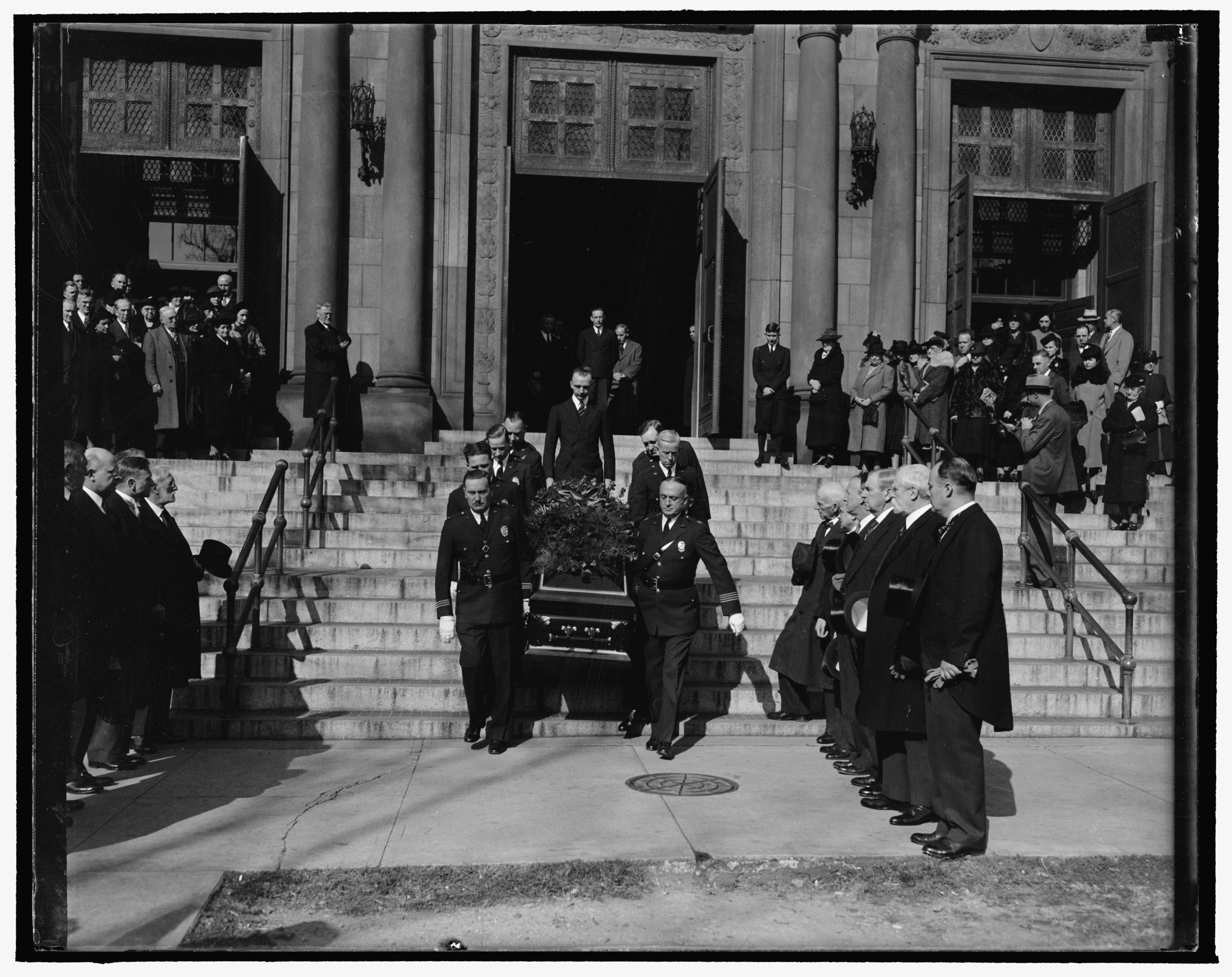
Pierce Butler died of leukemia on November 16, 1939, was eulogized in Washington, and buried in St. Paul.31 His grave, marked by an obelisk in the Butler family plot at Calvary Cemetery, lies not too far from that of a man he knew and admired, Archbishop John Ireland, and from that of his old political mate and courtroom rival, Fred McGhee.32
A Complicated Legacy
Who was Pierce Butler? It’s a question that is hard to answer, made harder by Butler himself. Before he died, he directed his clerk to destroy his Supreme Court papers. This direction, of doubtful propriety (he was, after all, an employee of the United States) deprives posterity of essential information and invites speculation. What was he hiding? We are left with an incomplete record.
Butler deserves to be remembered in Ramsey County as the best Minnesota trial lawyer of his generation. He was an energetic public figure and as a regent of the University of Minnesota he was completely devoted, but he could also be rigid and intolerant. His persecution of Warren Schaper for “insufficient patriotism” cannot be defended.
As a Supreme Court justice, Pierce Butler was dutiful and hardworking. He lacked flexibility, but he probably would have said that what the job required instead was fidelity to tradition. Among scholars, the consensus has been that he ranks among the lower tiers of justices. Even former Minnesota Supreme Court Justice David Stras, a modern conservative, was able to mount only a tepid and unconvincing defense of Butler’s record.33 Butler was a nineteenth-century thinker caught up in the twentieth-century maelstrom of the Great Depression and a profound rethinking of constitutional law. The verdict of history—always temporary and contingent—has been that he held on mulishly to outmoded ideas, ideas that also happened to serve very well the nation’s wealthy. Pierce Butler was no crank; he believed the meaning of the Constitution (as he understood it) was unchanging and unchangeable; its principles were fixed and eternal, and if they bent to the pressures of the times, they were no principles at all.
Events in the ninety years since Tipaldo remind us that in American law, as in life, things sometimes go in cycles.34 Pierce Butler adhered to a view of the Constitution in which “the right of contract” was sacred; this had been a prevailing view for decades. But just nine months after Tipaldo, in West Coast Hotel v. Parrish,35 the Supreme Court, through Chief Justice Hughes, put an end to that approach; freedom of contract wasn’t sacred after all.36 One era of Constitutional law had come to an end, and a new one began. In the new era, government could act to intervene decisively in relations between employer and employee. It was revolutionary in the sense that an old regime had been toppled and a new one installed. The new one, which led to the Warren Court’s expansion of civil rights and liberties, has lasted for nearly a century.
But a new cycle may have begun. The current Supreme Court majority, using an approach known as “originalism,”37 embrace an old constitutional creed of long ago, limiting privacy rights,38 voting rights,39 affirmative action,40 health care for minors,41 as well as a host of shadow docket rulings that curtail Congress’s appropriations authority.42 Almost as quickly as the 1937 West Coast Hotel ruling swung the pendulum left, today the pendulum swings in the other direction. Pierce Butler would probably be pleased.
James D. Fleming is a retired attorney who in thirty-six years of practice served as Chief Public Defender in the Fifth and Second Judicial Districts in Minnesota. Fleming serves on the Board of the Ramsey County Historical Society and lives in Minneapolis.
Paul Nelson is an amateur historian, the author of Fredrick L. McGhee: A Life on the Color Line 1861-1912, and many articles of Minnesota history published in Ramsey County History, Minnesota History, MNopedia, and other publications.
Notes
- In their 1978 book The First One Hundred Justices: Statistical Studies on the Supreme Court of the United States, law professors Albert P. Blaustein and Roy M. Mersky relied on a 1970 survey of sixty-five professors of law, history, and political science from prestigious universities. Butler was one of eight rated a failure, along with his mates Van Devanter and McReynolds, evidently for their opposition to the New Deal as a bloc.
- In his Vanderbilt Law Review article about Butler, David Stras—the Trump-appointed Court of Appeals judge and former justice of the Minnesota Supreme Court—tries, without much success, to rehabilitate Butler’s reputation: “Scholars have characterized his role in the development of constitutional law as ‘minimal’ . . . Some scholars have gone even further by characterizing Butler’s tenure on the Court as a ‘failure,’ and when he is mentioned, it is often on lists of the least successful Supreme Court Justices of all time.” David R. Stras, “Pierce Butler: A Supreme Technician,” Vanderbilt Law Review, 62(2), March 2009, 696.
- David J. Danelski, A Supreme Court Justice is Appointed (Random House, 1964), 145-46.
- Robert C. Post, The Taft Court, Making Law for a Divided Nation, 1921-1930 (Cambridge University Press, 2024), 61.
- See Daniel Okrent, The Guarded Gate: Bigotry, Eugenics and the Law That Kept Two Generations of Jews, Italians, and Other European Immigrants Out of America (Scribner, 2020).
- “Grey Wigs,” Time Magazine 8, October 11, 1926, 8. Quoted in Post, 62.
- Post, 61.
- Post, 65. See also David Schroeder, More Than a Fraction: The Life and Work of Justice Pierce Butler (PhD diss., Marquette University, 2009), 163. William O. Douglas in his diary describes Butler as “a powerful advocate. . . . When you cross swords with him you have a worthy opponent.”
- The numbers are based on the authors’ compilation of Butler’s opinions, which itself is based in part on Lorraine Gardner’s typescript compilation, Supreme Court Justice Pierce Butler, found at the Minnesota Historical Society.
- Barry Cushman, “The Secret Lives of the Four Horsemen,” 83 Virginia Law Review 559 (1987). In this difficult essay the author comments, “For more than two generations scholars have seen The Four Horsemen as far right, reactionary, staunchly conservative apostles of laissez-faire and Social Darwinism. And with good reason.”
- Pierce Butler III, interviewed by Robert Goff and Lila Johnson, Minnesota Historical Society, June 19, 1968, 13.
- The sequence of events is well told in “The Origins of Franklin D. Roosevelt’s ‘Court-Packing Plan,’ ” the fourth chapter of William E. Leuchtenberg, The Supreme Court Reborn: The Constitutional Revolution in the Age of Roosevelt (Oxford University Press, 1995), 82-131. The cases were, in order: Panama Refining Co. v. Ryan (1935), Railroad Retirement Board v. Alton Railroad (1935), Schechter Poultry Corp. v. United States (1935), Louisville Joint Stock Land Bank v. Radford (1935), United States v. Butler (1936), and Carter v. Carter Coal Co. (1936).
- Adkins v. Children’s Hospital, 261 U.S. 525 (1923).
- Stras, “Pierce Butler: A Supreme Technician,” 733.
- Morehead v. New York ex rel. Tipaldo, 286 U.S. 587, 611 (1936).
- The quotation comes from the mouth of an oddball character in his 1894 novel, The Red Lily (Dodd-Mead & Company), 91.
- Tipaldo.
- Leuchtenburg, The Supreme Court Reborn, 105.
- Leuchtenburg, The Supreme Court Reborn, 92-93.
- James F. Simon, FDR and Chief Justice Hughes: The President, The Supreme Court and the Epic Battle Over the New Deal (Simon and Schuster, 2012), 291.
- “Rubber Stamp Court,” Minneapolis Journal, February 10, 1937, 14.
- Leuchtenburg, The Supreme Court Reborn, 153-54.
- Simon, FDR and the Chief Justice, 290.
- West Coast Hotel Co. v. Parrish, 300 U.S. 379, 398 (1937).
- William E. Leuchtenberg, “The Case of the Chambermaid and the Nine Old Men,” American Heritage vol. 38, no. 1, December 1986.
- “Willis Van Devanter, 1911-1937,” Supreme Court Historical Society, accessed July 12, 2025, https:// supremecourthistory.org/associate-justices/willis
-van-devanter-1911-1937/; “George Sutherland, 1922-1938,” Supreme Court Historical Society, accessed July 12, 2025, https://supremecourthistory.org/associate-justices/george-sutherland-1922-1938/. - This tally is based on the authors’ compilation of Butler’s dissenting votes. Despite the increase in dissents, Butler voted with the majority in most cases—despite everything, most decisions were unanimous because most cases lacked controversy.
- “Kevin Butler to Be Buried Monday,” Pioneer Press, February 12, 1938, 9.
- “Kevin Butler,” Ancestry.com, https://wwwancestry.com/search/collections/5164/records/3189037. The death certificate records that the primary causes of death were shock and skull fracture “due to fall out of window of train.” As for the crucial question, what caused the fall: “cause undetermined.”
- “Leaps From Speeding Train,” Minneapolis Star, February 10, 1938, 1. All other accounts, including later in the Star, used “fell,” rather than “leaped.”
- “Pierce Butler’s Career: The Story of Rise from Log Cabin Boyhood,” Minneapolis Star-Journal, November 16, 1939, 4. Most press accounts specified only “bladder problem” as the cause of death, but his grandson Pierce Butler III said it was “acute leukemia.” “Interview with Pierce Butler III, Minnesota Historical Society.
- “Calvary Cemetery,” Catholic Cemeteries, accessed April 3, 2026, https://catholic-cemeteries.org/calvary/.
- Stras, “Pierce Butler: A Supreme Technician.”
- William Strauss and Neil Howe, The Fourth Turning: An American Prophecy (Crown, 1997) 20-21.
- West Coast Hotel Co. v. Parrish, 300 U.S. 379 (1937).
- West Coast Hotel Co., 300 U.S. at 391-93.
37 Jonathan Gienapp, Against Constitutional Originalism: A Historical Critique (Yale University Press, 2024).
- Dobbs v. Jackson Women’s Health Organization, 597 U.S. 215 (2022).
- Shelby County v. Holder, 570 U.S. 529 (2013), Louisiana v. Callais 608 U.S. ___ (2026).
- Students for Fair Admissions v. Harvard, 600 U.S. 181 (2023).
- United States v. Skrmetti, 605 U.S. 495 (2025).
- U.S. Doge Service v. Citizens for Responsibility and Ethics in Washington (2025), McMahon v. New York (2025), Rhode Island State Council of Churches v. Rollins (2025).
- Year
- 2026
- Volume
- 61
- Issue
- 2
- Creators
- Paul Nelson and James Fleming
- Topics